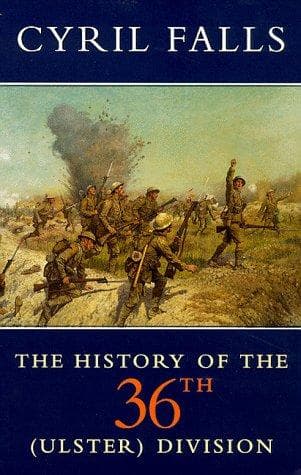
The History of the 36th (Ulster) DivisionFalls, Cyril
History
The History of the 36th (Ulster) Division
Falls, Cyril
Great Britain. Army. Division, 36th; World War, 1914-1918 -- Regimental histories -- Great Britain
Of the deeds of heroism that day accomplished, it is not possible to
enumerate one-hundredth. Notable among them were the achievements
of junior officers and N.C.O.'s when their seniors had fallen.
Lieutenant H. Gallagher, 11th Inniskillings, was the sole officer
of his battalion to cross the German front line. With his orderly's
rifle he killed six Germans holding up the advance, and then, at the
Crucifix, organized the resistance, being one of the last to quit
the German trenches at night. Lieutenant Sir Harry Macnaghten, 12th
Rifles, twice reformed the tatters of his company in "No Man's Land,"
and led them against gaps in the German wire, to fall himself on the
second occasion. Corporal John Conn, 9th Inniskillings, came upon two
of our machine-guns out of action. He repaired one under fire and
annihilated a German flanking party. He carried both guns himself
most of the way back, but had to abandon one at last owing to utter
exhaustion. These are but examples, picked at random. Another very
remarkable Victoria Cross was that won by Private Quigg, 12th Rifles,
Sir Harry Macnaghten's servant. He had, on July the 1st, advanced
thrice to the attack. Next morning he heard a rumour that his officer
was out wounded in "No Man's Land." Seven times he went out to look
for him, and seven times he brought in a wounded man, the last
dragged on a waterproof sheet from within a few yards of the German
wire.
All arms had supported the infantry finely in their great, heroic
achievement. The work of the artillery could not have been bettered.
It carried out its long and gruelling task to perfection. Even in
front of the "D" line the wire was well cut. One forward battery of
the 172nd Brigade in Hamel, in full view of the enemy, enfiladed his
lines across the Ancre, doing great execution and being handled with
extreme gallantry. The Engineers suffered very heavy casualties in
their devotion to duty, working in the marsh at keeping repaired the
vital pipe-lines, regardless of the shells that all day fell about
them. The stretcher-bearers of the R.A.M.C. were tireless. Often,
owing to break-down on the trench tramway due to shell-fire, they had
to carry wounded right down from Thiepval Wood and across the Ancre
at Authuille. Many dropped from sheer exhaustion, and many refused
to rest when reliefs arrived. The Army Service Corps drivers of the
ambulances kept their cars continuously on the roads for thirty-six
hours. There was throughout no hitch in the medical arrangements,
though at one period of the day the overcrowding of the Main Dressing
Station at Forceville, due to the strain upon the Motor Ambulance
Convoy which evacuated the wounded to the Casualty Clearing Stations,
gave rise to much anxiety.
Public-domain text, read in full here on John Shaqi.
Reviews
Reviews
No reviews yet
Be the first to share your thoughts on this work.
Elsewhere in the archive
Join the Discussion
Join the discussion
Sign in to leave a comment or review.
Sign InorCreate an account