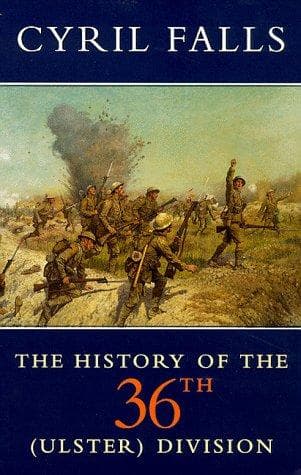
The History of the 36th (Ulster) DivisionFalls, Cyril
History
The History of the 36th (Ulster) Division
Falls, Cyril
Great Britain. Army. Division, 36th; World War, 1914-1918 -- Regimental histories -- Great Britain
On July the 5th the Division moved back to Rubempré and the
neighbouring villages, and five days later to the Bernaville area.
The Artillery remained in line under the orders of the 49th Division,
while the Pioneers, 121st and 122nd Field Companies, were left
several days at work, the former having, amongst other unpleasant
tasks, to make a communication trench across "No Man's Land" to the
new-won ground.[24] The 150th Field Company had a yet harder time. It
was sent to the 12th Division, further south, in the neighbourhood
of Ovillers, where a slight advance had been made. Its work here was
the consolidation of strong points, "before they were taken," as its
commander, Major Boyle, remarks.
[Illustration: Map I.
The Battle of Albert, 1916.]
Orders came at Bernaville for a move to Flanders. The Engineers,
relieved of their task, marched north. The rest of the Division, less
the Artillery, was moved by train from Auxi-le-Château, Frévent, and
Conteville, to Berguette, Thiennes, and Steenbecque, between Aire and
Hazebrouck, on its way to the training area west of St. Omer. The
infantry battalions were but shadows of their former selves. Well
might commanding officers feel appalled at the magnitude of the task
before them in building up anew, without the best of their officers
and N.C.O.'s. The men were very silent in these first few days after
the battle. Not one of the survivors but had lost companions who had
been two years at his side; many, friends of a lifetime. But if ever
gift be God-given, it is the healing effect of time. And in days of
war a week even is a long period. These men, moreover, felt that in
all that had happened there was no reproach for them. They, at least,
had accomplished their task in the face of incredible difficulties.
On the 12th of July, General Nugent and his Staff saw the battalions
of the 107th Brigade marching from the station of Thiennes into
Blaringhem. Sun was shining on the old Flemish village. Officers
and men wore marigolds in caps to honour the day; the bands played
"King William's March." The least practised eye could tell that to
these men confidence was returning; that the worst of the horror they
had endured had been shaken from their shoulders. They marched like
victors, as was their right.
FOOTNOTES:
[19] See Map I.
[20] For a brilliant appreciation of the Somme Battle and its
lessons, General Mangin's book, _Comment finit la Guerre_, should be
read.
[21] The boundaries of the 36th Division, with all names that occur
in the description of the battle, will be found in Map I.
[22] The "A" line consisted of a double line of trenches, a front
line, and immediate support. The second was alluded to as the "A.I."
line.
[23] Z/49 Trench Mortar Battery was attached to the 36th Division for
this operation.
[24] It was not held for long, nor was the Schwaben Redoubt to come
again into British hands for several months.
CHAPTER IV
FROM THE SOMME TO MESSINES: JULY 1916 TO JUNE 1917
Public-domain text, read in full here on John Shaqi.
Reviews
Reviews
No reviews yet
Be the first to share your thoughts on this work.
Elsewhere in the archive
Join the Discussion
Join the discussion
Sign in to leave a comment or review.
Sign InorCreate an account