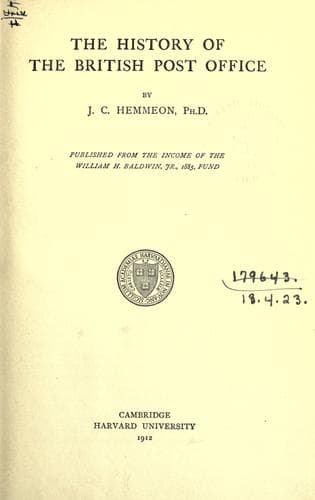
The History of the British Post OfficeHemmeon, Joseph Clarence
History
The History of the British Post Office
Hemmeon, Joseph Clarence
Postal service -- Great Britain -- History
Before the introduction of Penny Postage, the use of railways had only
started. In 1837, it was objected that the railways could never be of
much use in this respect because they could not travel at night for
fear of accidents. In answer to this objection it was pointed out that
trains between Liverpool and Manchester and Leeds and Selby found no
difficulty in that respect.[427] In 1837, mails were carried between
Manchester and Liverpool at a rate of twenty miles an hour, and these
trains left both Liverpool and Manchester as late as 5 P.M.[428] The
Postmaster-General was given authority by Parliament to require any
railway to carry mails either by ordinary or special train and to
regulate the speed to the maximum of the fastest passenger train, as
well as to control places, times and duration of stoppage and the times
of arrival, provided that such regulations were reasonable. He might
require the exclusive use of a carriage, if necessary, provided either
by the railway or himself as seemed better to himself. In 1844 he was
allowed to order a speed not in excess of twenty-seven miles an hour but
he complained that he was unable to enforce his regulations although the
speed was increasing. In 1855 a parliamentary committee reported in
favour of a deduction of payment for irregularity on the part of the
railways and the fining of the Post Office for irregularity in dealing
with mail to be entrusted to the railways, the amounts of such
deductions and fines to be a matter of contract, and in addition it was
advised that the Postmaster-General's demands with reference to speed
should be certified by the Railway Department of the Board of Trade to
be consistent with safety. In conformity with this resolution, the
Postmaster-General proposed to pay a bonus to the railways when their
trains were on time and to exact a penalty from either the railway or
the Post Office whichever were the offender, but the proposition was, as
a rule, not very favourably received by the railways.[429]
[427] _Rep. Com._, 1837-38, xx, pt. 1, p. 469, no. 17.
[428] _Rep. Commrs._, 1837, xxxiv, 7th rep., app., no. 13.
[429] 1 and 2 Vict., c. 98; 7 and 8 Vict., c. 85; _Rep. Com._, 1854, xi,
411, p. xiii; _Rep. P. G._, 1857, p. 7.
CHAPTER VII
SAILING PACKETS AND FOREIGN CONNECTIONS
Public-domain text, read in full here on John Shaqi.
Reviews
Reviews
No reviews yet
Be the first to share your thoughts on this work.
Elsewhere in the archive
Join the Discussion
Join the discussion
Sign in to leave a comment or review.
Sign InorCreate an account