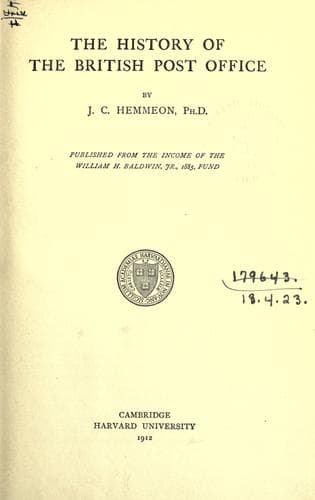
The History of the British Post OfficeHemmeon, Joseph Clarence
History
The History of the British Post Office
Hemmeon, Joseph Clarence
Postal service -- Great Britain -- History
Early in the sixteenth century Dover was the port of departure and
arrival for letters to and from the continent, and Calais was the
distributing point on the other side, although the royal mail was
occasionally conveyed between Rye and Dieppe.[443] From Calais the
letters were carried to their destination by the English messengers to
whom they were entrusted. They took up post horses along the way, paying
for them as they proceeded, and often grumbling at the excessive charges
which were demanded.[444] Letters from abroad directed to England were
usually carried as far as Calais by foreign messengers. The foreign
Postmaster-General would then send his bill to the English
Postmaster-General for expenses so incurred.[445] Regular sailing
packets were not used to carry the mails between Dover and Calais during
the sixteenth century, but merchant vessels were employed by the Post
Office.
[443] _Cal. S. P. D._, 1581-90, p. 485.
[444] _Cal. S. P. For._, 1553-58, pp. 239, 341.
[445] _Cal. S P. D._, 1580-1625, p. 188; 1581-90, p. 84; _L. & P. Hen.
VIII_, i, 3639.
Witherings' appointment as Foreign Postmaster-General in 1632 was made
the occasion for a report to Sir John Coke on the foreign postal
service. The immediate cause of the report was the fact that mails had
not arrived from Germany, the Hague and Brussels. The fault was laid
upon the messengers, who were accused of "minding their own peddling
traffic more than the service of the state or the merchants, omitting
many packages, sometimes staying for the vending of their own
commodities, many times through neglect or lying in tippling houses."
The report goes on to express confidence in Witherings and in his plan
for the reform of the foreign post.[446] In 1631, thirteen messengers
were employed to carry letters to the continent: three for France; six
for Germany, Italy and the Netherlands; and four, who travelled to Paris
and other parts of France on special occasions.[447] The service which
they gave was inadequate and slow, and in 1633 the foreign post, at
Witherings' suggestion, was ordered to be conducted on the following
principles. Packet posts were to be appointed at suitable stages to run
day and night without stopping. This was the plan which was commented
upon favourably in the report to Sir John Coke. The Foreign
Postmaster-General was to take the oaths of Allegiance and Supremacy, to
have an office in London, and to give notice at what time the public
were to bring in their letters for despatch to the continent. A register
was also to be kept, in which should be enrolled the names of all
persons bringing letters, together with the names of those to whom they
were addressed. The letters themselves were placed in a packet and
locked and sealed with the Foreign Postmaster-General's seal. Letters
from abroad for ambassadors residing in England and for the Government
were to be delivered at once, after which a table of all other letters
Public-domain text, read in full here on John Shaqi.
Reviews
Reviews
No reviews yet
Be the first to share your thoughts on this work.
Elsewhere in the archive
Join the Discussion
Join the discussion
Sign in to leave a comment or review.
Sign InorCreate an account