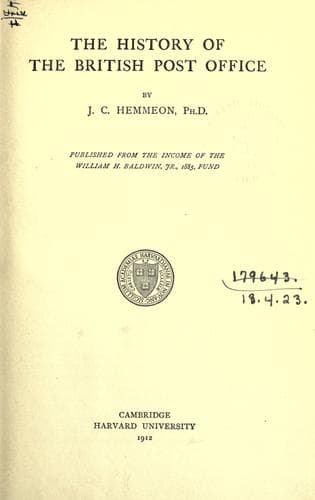
The History of the British Post OfficeHemmeon, Joseph Clarence
History
The History of the British Post Office
Hemmeon, Joseph Clarence
Postal service -- Great Britain -- History
Until 1638, Flanders was the only country with which England had come to
an agreement concerning the mutual exchange of the correspondence of
each. In that year, a similar agreement was concluded with de Nouveau,
the French Postmaster-General. All letters between England and France
were henceforth to pass through Dover, Calais, Boulogne, Abbeville, and
Amiens. Both the French and English kings ratified this agreement, and
all others were prohibited by them from infringing upon the monopolies
enjoyed by the two Postmasters-General.[452] On special occasions, of
course, both the French and English kings sent special messengers but
they were not used so often as before.[453] In 1640, the Governor of the
Merchant Adventurers was asked to give his opinion upon the question of
foreign correspondence concerning which there was considerable
dissatisfaction, especially in the case of letters sent to Flanders and
Holland. The Governor in his reply said that complaints had hitherto
been restrained because of the connection of the state with the foreign
post. He added that some time before a letter had come from the Court of
their company at Rotterdam, complaining about the overcharging of the
Company's letters. He did not care to investigate the question alone but
proposed that it be entrusted to a committee composed of two members
from each of the great companies, the Merchant Adventurers, the Turkish,
the Eastland, and the French.[454] After the Restoration, matters were
adjusted with de Nouveau and provision was made for the transmission of
letters to England twice a week.[455] At the same time an attempt was
made to reach an understanding with the burgomaster of Amsterdam and the
Dutch ambassador for the conveyance of English letters to Germany, the
East, and Italy through Holland. Bishop, the English Postmaster-General,
was accused of accepting money for making this bargain and the proposed
agreement did not materialize.[456] In 1665, Frizell was sent abroad to
talk over postal connections with de Nouveau and the Flemish
Postmaster-General, de Taxis, between whom difficulties had arisen. De
Taxis was reminded that letters from Holland for England passing through
Flanders were not treated in accordance with the agreement made between
England and Flanders.[457] The old contract was continued, for in 1693 a
bill was presented to the English Post Office by the next in order of
the House of Thurn and Taxis, referring to the former agreement. £2711
was then due to the Flemish Postmaster-General and, as the bill was
presented in the form of a petition signed by the Prince of the House
and his brothers and sisters, there was probably some difficulty
experienced in collecting it.[458] The Dutch were not satisfied with
receiving letters through Flanders, and in 1667 we find the
Postmaster-General of Holland in Harwich, arranging for a direct service
with England, which was established in the following year.[459] Letters
Public-domain text, read in full here on John Shaqi.
Reviews
Reviews
No reviews yet
Be the first to share your thoughts on this work.
Elsewhere in the archive
Join the Discussion
Join the discussion
Sign in to leave a comment or review.
Sign InorCreate an account