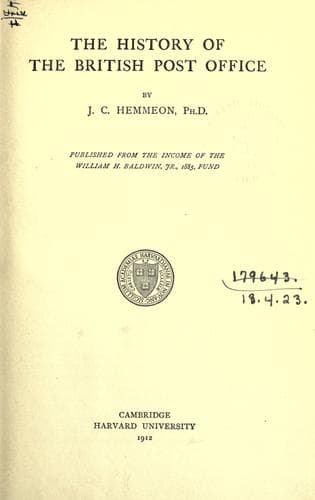
The History of the British Post OfficeHemmeon, Joseph Clarence
History
The History of the British Post Office
Hemmeon, Joseph Clarence
Postal service -- Great Britain -- History
At the time of the War of the Austrian Succession, the Dover packets
were supplied by a man named Pybus. He agreed to carry mails,
passengers, and expresses from Dover to Calais and Ostend. If he could
not reach the latter place by sea he was to land the mails and have them
forwarded overland. He was to receive as pay the fares of all
passengers, but so many officers and soldiers had to be transported free
that he was paid what the Treasury considered that he lost by them.[469]
A position in one of the packets was so dangerous in time of war that a
fund was provided for the widows and children of the killed and for the
support of the wounded. This was met by deducting 10_d._ a month from
the pay of each seaman.[470]
[469] _Cal. T. B. & P._, 1742-45, p.509.
[470] _Cal. T. P._, 1708-14, p. 3.
In 1803, as a war measure, packets were established between Falmouth,
Gibraltar, and Malta.[471] It was understood that the regular service to
Portugal should be discontinued at the same time. In 1812 during
Wellington's campaign in Portugal and Spain, the Post Office announced
that sailing packets would be despatched to Corunna every
fortnight.[472] From Corunna they proceeded to Lisbon before returning
to Falmouth. There was some complaint from the mercantile interests on
account of the stop at Corunna, since the merchants were more interested
in the Lisbon markets than in keeping up communication with Wellington's
army.[473]
[471] 43 Geo. III, c. 73.
[472] London _Times_, 1812, Aug. 31, p. 2.
[473] _Ibid._, 1813, Aug. 22, p. 2.
By the end of 1813, Napoleon had lost control over Europe. The Dutch had
freed themselves from French domination. On November 26th a Dutch mail
was made up at the Post Office and despatched for Harwich. The regular
packet boats were reëstablished and were ordered to land the mails at
Scheveningen, a small fishing town three miles from the Hague.[474]
Following Napoleon's expulsion to Elba, postal communications with
France were resumed. Mails were despatched from Dover four times a week,
on Tuesday, Wednesday, Thursday, and Friday, leaving London at 11 P.M.
on Tuesday and Friday and at 7 P.M. on Wednesday and Thursday.[475]
Thirteen sailing vessels were stationed at Harwich in 1828, all of them
hired permanently. Nine sailed between Harwich and Helvoetsluys, four
between Harwich and Gothenburg.[476]
[474] _Ibid._, 1813, Nov. 29, p. 3.
[475] _Rep. Commrs._, 1829, xi, p. 232; _Acc. & P._, 1817, p. 11; London
_Times_, 1814, April 18, p. 3.
[476] _Rep. Commrs._, 1830, xiv, app., no. 78.
Public-domain text, read in full here on John Shaqi.
Reviews
Reviews
No reviews yet
Be the first to share your thoughts on this work.
Elsewhere in the archive
Join the Discussion
Join the discussion
Sign in to leave a comment or review.
Sign InorCreate an account