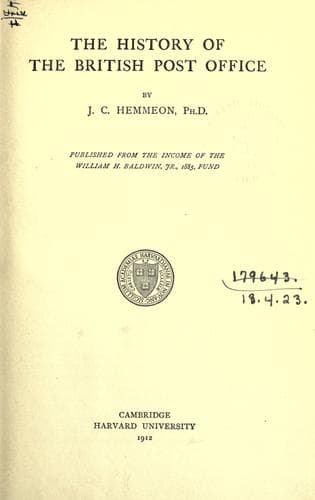
The History of the British Post OfficeHemmeon, Joseph Clarence
History
The History of the British Post Office
Hemmeon, Joseph Clarence
Postal service -- Great Britain -- History
By the same act which gave the Postmasters-General authority to forward
letters by vessels other than the regular sailing packets, rates were
fixed for the carriage of such letters. For every single letter brought
into the kingdom by these vessels, 4_d._ was to be charged. The
Postmasters-General might order such rates to be payable in advance or
on delivery. This was in addition to the inland postage, and for every
letter handed over to the Post Office, the captain was to receive 2_d._
The revenue arising from this act was payable to the Exchequer.[593]
[593] 39 Geo. III, c. 76.
In 1801 the Post Office was called upon again to make a further
contribution to the Exchequer to help meet the interest on new loans.
The following were the new rates for a single letter:--
_Within Great Britain by the General Post_
_d._
Not exceeding 15 measured miles 3
Above 15 but not exceeding 30 measured miles 4
30 50 5
50 80 6
80 120 7
120 170 8
170 230 9
230 300 10
_d._
For every 100 miles above 300 miles an additional rate of 1
Where the distance above 300 miles did not amount to 100 miles
an additional rate of 1
Where the distance above 300 miles exceeded 100 miles and for
every excess of distance over 100 miles an additional rate of 1
By the act of 1796 a uniform rate of 8_d._ for a single letter had been
paid for distances over 150 miles. The new act not only imposed extra
rates for all distances over 150 miles but it decreased the distances
above 30 miles for which the old postage would have paid. For instance,
a 6_d._ rate had carried a single letter 100 miles, a 7_d._ rate 150
miles. They now carried only 80 and 120 miles respectively.
On letters to and from places abroad, "not being within His Majesty's
Dominions," an additional rate of 4_d._ for a single letter was
imposed.[594] In London, where a penny had been charged for the
conveyance of letters by the Penny Post, 2_d._ was now charged. An
additional rate of 2_d._ for a single letter was imposed upon letters
passing between Great Britain and Ireland via Holyhead or Milford. The
Postmasters-General were given authority to convey letters to and from
places which were not post towns for such sums for extra service as
might be agreed upon. Merchants' accounts and bills of exchange which,
when sent out of the kingdom or conveyed into it, had not formerly been
charged postage over the letters in which they were enclosed, were now
to be rated as letters.[595]
Public-domain text, read in full here on John Shaqi.
Reviews
Reviews
No reviews yet
Be the first to share your thoughts on this work.
Elsewhere in the archive
Join the Discussion
Join the discussion
Sign in to leave a comment or review.
Sign InorCreate an account