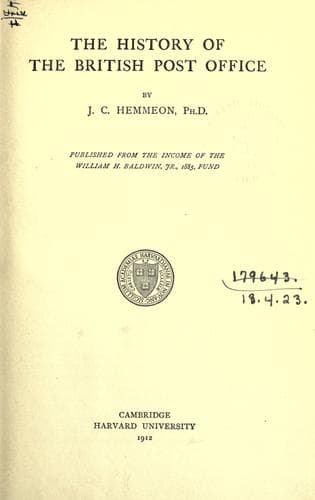
The History of the British Post OfficeHemmeon, Joseph Clarence
History
The History of the British Post Office
Hemmeon, Joseph Clarence
Postal service -- Great Britain -- History
In Ireland, Parliament met as a rule only during the even years or if it
met every year, the sessions in the odd years were very short. For the
five even years from 1753 to 1762, the expenses averaged for each year
£3306 over the receipts, while during the five odd years, the receipts
were greater than the expenditures by a yearly average of £2249. These
general results held good for every individual odd or even year for the
period for which returns were given.[649]
[649] _Ibid._, 1761-64, p. 1001.
Attempts continued to be made by members of the House of Commons to
diminish the abuses arising from franking. There had been some
misunderstanding as to whether they were entitled to have ship's letters
delivered free to them. Of course they were exempt from the inland
postage on such letters, but for every letter brought into the country
by vessels other than packets, the master was paid one penny and this
penny was collected from the person to whom the letter was delivered.
The members finally agreed to pay the extra penny.[650]
[650] _Ibid._, 1780-82, p. 537.
Acts were now introduced to enable the Commander-in-Chief, the
Adjutant-General, and the Controller of Accounts of the Royal forces to
receive and send letters free. Both bills passed.[651] It is some
consolation that the Lord Chancellor and Judges failed to obtain the
franking privilege although a bill was introduced in the Commons in
their behalf.[652]
[651] 22 Geo. III, c. 70; 23 Geo. III, c. 69.
[652] _Jo. H. C._, 1790-91, p. 468.
It was enacted in 1784 that a member must write on his free letters not
only his name and address but also the name of the post town from which
they were to be sent and the day of the month and the year when they
were posted.[653] The object of this restriction could be easily evaded
by enclosing postdated letters to their constituents but, after the
passage of this resolution, a considerable decrease resulted in the
number of free letters to and from members.[654] When the Irish was
separated from the English Post Office, the privilege of franking
newspapers to Ireland was taken away and a rate of one penny a newspaper
was imposed, payable in advance. This meant a loss to the clerks in the
Secretaries' offices but this was made good to them by an addition of
£1000 a year to their salaries.[655]
[653] _Ibid._, 1784-85, p. 383. The Lords also agreed to this resolution
(ibid., p.411; 24 Geo. III, sess. 2, c. 37).
[654] For the years 1783 and 1784, the number of free letters arriving
in London, exclusive of the state's letters, averaged over 800,000 a
year and those sent from London averaged over 1,000,000. In 1785, they
had fallen to 514,000 and 713,000 respectively (_Parl. Papers_, 1812-13,
_Rep. Com._, ii, 222, p. 95).
[655] 24 Geo. III, c. 6; _Jo. H. C._, 1795-96, p. 588.
Public-domain text, read in full here on John Shaqi.
Reviews
Reviews
No reviews yet
Be the first to share your thoughts on this work.
Elsewhere in the archive
Join the Discussion
Join the discussion
Sign in to leave a comment or review.
Sign InorCreate an account