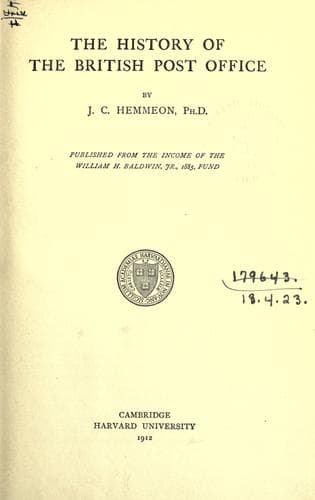
The History of the British Post OfficeHemmeon, Joseph Clarence
History
The History of the British Post Office
Hemmeon, Joseph Clarence
Postal service -- Great Britain -- History
During the Crimean War, the Army Post Office was authorized to issue
money orders at inland rates and the system was extended to Gibraltar
and Malta. In 1858 a proposition advanced by Canada for the interchange
of money orders was favourably received by the Home Government, and in
the following year provision was made for their issue between the United
Kingdom and Canada at four times the inland rates, to a limit of £5. In
1862 the system was extended to all the colonies, the rates being the
same as those already agreed upon with Canada except in the case of
Gibraltar and Malta where they were three times the inland rates, and
the maximum was increased to £10. In 1868 a money order convention was
concluded with Switzerland, the rates being the same as those for inland
orders, and in 1869 a similar agreement was made with Belgium, but in
1871 the rates for both countries were increased to three times the
inland rates upon the same terms as those prevailing with other parts of
Europe. In 1880 colonial rates were reduced to the same level, and in
1883 the following changes were adopted:
_d._
On orders not exceeding £2 6
£5 12
£7 18
£10 24
These were superseded in 1896 by the following rates:--
_d._
On orders not exceeding £2 6
£6 12
£10 18
By 1903 most foreign countries and some of the colonies had agreed to a
further reduction of rates and to a £40 limit. In 1905 the poundage on
foreign money orders not exceeding £1 in value was diminished from 4_d._
to 3_d._[698]
[698] _Rep. P. G._, 1896, pp. 28-30; 1897, pp. 10-11; 1904, p. 11; 1906,
p. 1.
There is no record of the yearly expenses of the Government for the
maintenance of the posts until the accession of James I.[699] There are
many instances of the issue of warrants for the payment of the posts but
it is not known how long a period they were intended to cover.[700]
There was no systematic financial method in dealing with this phase of
the postal question. The postmen remained unpaid for years at a time.
After sufficient clamour, part of the arrears would be met, but it is
impossible to say how much of the sum paid was for current expenses and
how much for old debts.[701] It might be supposed from the fact that
they received fixed daily wages that some idea might be obtained of the
cost of management. But their wages often remained unpaid and the number
of postmen varied, as new routes were manned or old routes discontinued,
so that any figures for the period before the seventeenth century would
be mere guesses.
[699] _Rep. Com._, 1844, xiv, app., p. 48 (25).
[700] _L. & P. Hen. VIII_, ii, pp. 1444-51-53-57-58-60-62-63-66-72; _A.
P. C._, 1547-50, pp. 111, 278, 307, 319, 413; 1552-54, pp. 74, 137, 402.
Public-domain text, read in full here on John Shaqi.
Reviews
Reviews
No reviews yet
Be the first to share your thoughts on this work.
Elsewhere in the archive
Join the Discussion
Join the discussion
Sign in to leave a comment or review.
Sign InorCreate an account