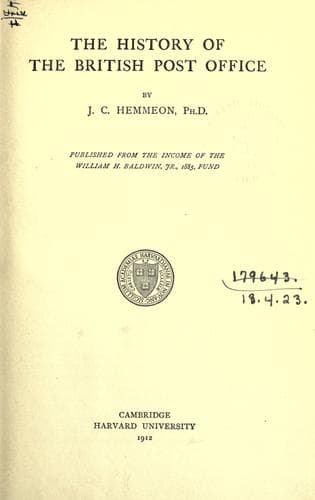
The History of the British Post OfficeHemmeon, Joseph Clarence
History
The History of the British Post Office
Hemmeon, Joseph Clarence
Postal service -- Great Britain -- History
Of all the interlopers up to the middle of the seventeenth century,
Oxenbridge had proved himself by far the ablest. From the point of view
of the legal decision of 1646 and the position of Parliament before
1640, his position was unassailable. With the present policy of the Post
Office in view, his actions will probably be condemned by the majority.
But in 1650 conditions were entirely different. Before 1635 the state
had either tacitly allowed the carriage of private letters to the profit
of the postmen or had officially taken over such carriage; but in this
case it was largely for the purpose of keeping in touch with the plots
of the times. For 200 years after 1635 the idea was to make money from
the conveyance of private letters. The effects of Oxenbridge's efforts
were certainly beneficial if we are to believe his own story. Prideaux
had been forced to cut his rates in half in order to meet competition.
The credit for this must lie with the interloper rather than with the
monopolist.
At the same time that Oxenbridge was giving so much trouble, letters
were being carried by private hands in Bury, Dover, and Norwich. The
offenders were summoned before the council for contempt and severely
reprimanded.[755] Petitions came from Thetford and Norwich complaining
that their messenger had been summoned to present himself before the
Council within twenty-four hours and had to travel 100 miles within that
time, an impossibility in the opinion of the petitioners.[756] As late
as 1635, Prideaux, the Attorney-General, gave his opinion that
Parliament's monopolistic resolution of that year affected only the
office of Postmaster-General and not the carrying of letters.[757]
Perhaps this was only a bit of spite on his part after Manley had
succeeded to his old position.
[755] _Ibid._, 1653-54, p. 177.
[756] _Ibid._, 1653-54, p. 25.
[757] _Ibid._, 1652-53, pp. 109-110.
Public-domain text, read in full here on John Shaqi.
Reviews
Reviews
No reviews yet
Be the first to share your thoughts on this work.
Elsewhere in the archive
Join the Discussion
Join the discussion
Sign in to leave a comment or review.
Sign InorCreate an account