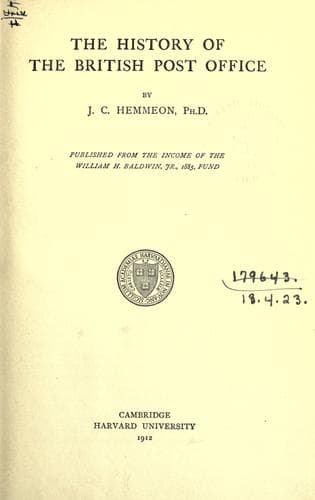
The History of the British Post OfficeHemmeon, Joseph Clarence
History
The History of the British Post Office
Hemmeon, Joseph Clarence
Postal service -- Great Britain -- History
In 1875, England joined the other important European powers in a
telegraphic agreement which went into effect in January of the following
year. By this agreement each of the contracting parties agreed to devote
special wires to international service, government telegrams to have
precedence in transmission and to be forwarded in code if desired.
Private telegrams could also be sent in code between those countries
which allowed them, and the signatory powers agreed to pass them in
transit, but each country reserved to itself the privilege of stopping
any private telegram. For the purpose of making charges, any country
might be divided into not more than two zones, and each of the signatory
powers owed to the others an account of charges collected.[815] So far
as foreign telegrams were concerned, the use of manufactured expressions
in place of real words gave rise to considerable trouble in view of the
fact that such combinations were difficult to transmit. In 1879, the
languages which might be used for code words were reduced by common
consent to English, French, German, Italian, Spanish, Portuguese, Dutch,
and Latin. At the same time the use of proper names as code words was
prohibited. This did not remove the evil, as the roots of words in one
language with terminations in another were used. An official vocabulary
was compiled by the International Telegraph Bureau, to become obligatory
in 1898, but its publication in 1894 aroused considerable opposition, as
many of the words were dangerously alike, and in 1896 the decision of
the Paris Conference of 1890, by which the official vocabulary was to
become compulsory for European telegrams in 1898, was rescinded. It was
also decided that an enlarged vocabulary should be published by the
International Bureau, but, owing to the action of the English delegates,
the official vocabulary was not made compulsory at the meeting of the
International Telegraph Conference in 1903, although artificial words
were allowed if pronounceable in accordance with the usages of any one
of the eight languages from which the ordinary code words might be
selected. It was also decided to admit letter cipher at the rate of five
letters to a word, and several countries agreed to lower their charges
for the transmission of extra-European telegrams, the English delegates
contending that the rates for such telegrams should be made the same as
the rates for European telegrams.[816] In 1878, negotiations with the
German and Netherland Telegraph Administrations resulted in a charge of
4_d._ a word being fixed as the rate between the United Kingdom and
Germany and 3_d._ a word between the United Kingdom and the Netherlands.
[815] _Acc. & P._, 1876, lxxxiv [c. 1418], pp. 116-119.
[816] _Rep. P. G._, 1904, pp. 15-22.
In 1885, the following reductions in rates were announced:--
Public-domain text, read in full here on John Shaqi.
Reviews
Reviews
No reviews yet
Be the first to share your thoughts on this work.
Elsewhere in the archive
Join the Discussion
Join the discussion
Sign in to leave a comment or review.
Sign InorCreate an account