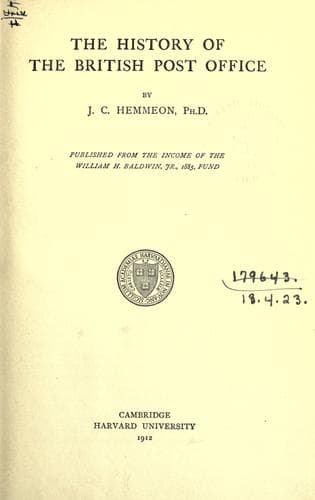
The History of the British Post OfficeHemmeon, Joseph Clarence
History
The History of the British Post Office
Hemmeon, Joseph Clarence
Postal service -- Great Britain -- History
the collection and delivery of the telegrams of the Marconi Company by
the post offices throughout the country. The company charges its usual
rate, 6_d._. a word, and the Post Office in addition charges the
ordinary inland rate.[818] The international agreement providing for
compulsory communication between shore stations and ships was signed in
1906 in spite of the protests of the Marconi Company, Sir Edward
Sassoon, and others, who contended that the agreement was unfair to the
company and a mistake on the part of the Kingdom, "which was thus giving
up advantages obtained by the possession of the best system of wireless
telegraphy in the world." The majority of the countries represented were
also in favour of compulsory communication between ship and ship, but
this was successfully negatived by Great Britain and Japan. In 1908, Mr.
Buxton was able to announce in the House that the relations between the
Post Office and the Marconi Company "are now of the most friendly kind,"
and that they have accepted and adopted the principle of
intercommunication. In the preceding year two experimental stations were
started by the Government which will enable the department to extend
its operations quite independently of the companies.[819]
[818] _Rep. P. G._, 1893, pp. 19-22; 1903, pp. 15-18; 1905, pp. 16-18; 4
Edw. VII, c. 24; 6 Edw. VII, c. 13.
[819] _Parl. Deb._, 4th ser., clxxix, coll. 841-858; cxcii, col. 1116,
London _Times_, 1906, Nov. 5, p. 5; 1907, July 1, p. 14.
From a financial point of view, government ownership and control of the
telegraphs in the United Kingdom has not been a success. In addition,
the Telegraph Department, for some time previous to 1874, had been
drawing upon the balance in the possession of the Post Office, a balance
which was required to be invested for other purposes and whose
expenditure for the use of the telegraphs had not been authorized by
Parliament. Mr. Goldsmid, in introducing a motion for the appointment of
a committee of enquiry, alluded to this error on the part of the
department, to the excessive price paid for the telegraphs, and
complained that the telegraph system was not being operated on a paying
basis. His motion was withdrawn, but an agreement was reached with the
department by the appointment of a committee, with Mr. Playfair as
chairman, "to inquire into the organization and financial system of the
Telegraph Department of the Post Office." The committee in their report
commented unfavourably upon the unnecessarily large force, the cumbrous
organization, and the far from economical management of some of the
divisions of the department, advised that an attempt be made to remedy
these faults, and that press messages be charged a minimum rate of 1_s._
each, and not at the rate of 1_s._ for each seventy-five or one hundred
words obtained by adding together separate messages requiring separate
transmission. This suggestion with reference to press messages was
Public-domain text, read in full here on John Shaqi.
Reviews
Reviews
No reviews yet
Be the first to share your thoughts on this work.
Elsewhere in the archive
Join the Discussion
Join the discussion
Sign in to leave a comment or review.
Sign InorCreate an account