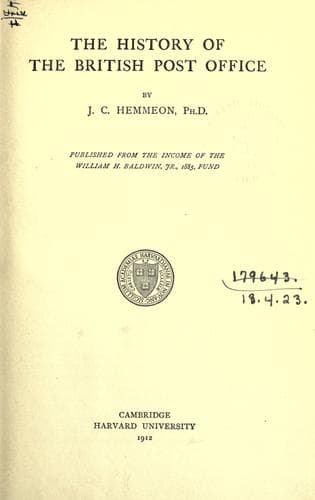
The History of the British Post OfficeHemmeon, Joseph Clarence
History
The History of the British Post Office
Hemmeon, Joseph Clarence
Postal service -- Great Britain -- History
In April of 1881 the Postmaster-General granted the United Telephone
Company a licence to establish and operate a telephone system within a
five-mile radius in London, the central point to be chosen by the
company. On the other hand the company agreed to pay a royalty of 10 per
cent of its gross receipts and to accept the judgment of the High Court.
Licences were also granted to establish telephone exchanges in the
provincial towns within a radius of one or two miles, all the licences
to expire in 1911. The Postmaster-General reserved the right to
establish exchanges for the department and the option of purchasing the
works of the licencees in 1890 or at seven-year intervals from 1890, six
months' notice having first been given. The policy of the United
Telephone Company was to confine its own operations to London and to
allow patent apparatus to be used in other parts of the country by
subsidiary companies, leaving them free to negotiate with the Post
Office for provincial licences.
The telephone policy of the Post Office from 1880 to 1884 consisted in
the granting of licences to the companies in restricted areas, so that
the telegraph revenue might suffer from competition as little as
possible, and the establishment by the department of exchanges in
certain places not as a rule served by the companies. Owing to the
refusal of the Government to solicit business, their exchanges did not
prove a success. The department itself would probably have preferred to
take over the whole telephone business in 1880, but this policy met with
no favour from the Lords of the Treasury, who were of the opinion "that
the state, as regards all functions which are not by their nature
exclusively its own, should at most be ready to supplement, not
endeavour to supersede private enterprise, and that a rough but not
inaccurate test of the legitimacy of its procedure is not to act in
anticipation of possible demands." The operation by the government of
the unimportant exchanges possessed by them was sanctioned by their
Lordships, "on the understanding that its object is by the establishment
of a telephonic system to a limited extent by the Post Office to enable
your department to negotiate with the telephone companies in a
satisfactory manner for licences." The London and Globe Company was
given a licence in 1882 to establish exchanges in London, but they were
entirely dependent upon the United Company for instruments, so that
there was no real competition. The department proceeded to issue
licences for the establishment of competing systems in places where
there were already government exchanges. From 1880 to 1884 the
Postmaster-General granted twenty-three licences, and some twenty-seven
towns, with 1141 subscribers, were served by the department. The policy
of the Post Office during these years, as thus outlined, was far from
satisfactory to the public, due largely to the desire to protect the
Public-domain text, read in full here on John Shaqi.
Reviews
Reviews
No reviews yet
Be the first to share your thoughts on this work.
Elsewhere in the archive
Join the Discussion
Join the discussion
Sign in to leave a comment or review.
Sign InorCreate an account