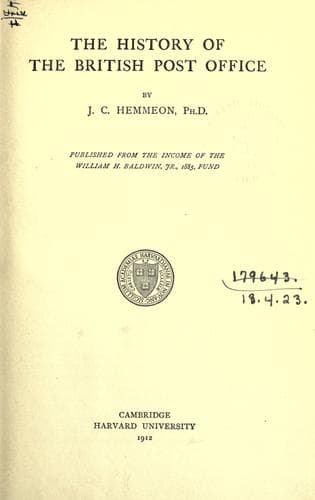
The History of the British Post OfficeHemmeon, Joseph Clarence
History
The History of the British Post Office
Hemmeon, Joseph Clarence
Postal service -- Great Britain -- History
In 1905, the Postmaster-General and the National Telephone Company
concluded an agreement for the purchase of the company's provincial
plant based upon much the same principles which had governed the London
agreement. The question of purchase in the provinces was complicated by
the fact that in some towns there were competing municipal telephones, a
resulting duplication of plant, and an extension of the licence period
beyond 1911. By the terms of the agreement, the Postmaster-General on
the 31st of December, 1911, shall buy and the National Telephone Company
shall sell (_a_) "all the plant, land, and buildings of the company
brought into use with the sanction of the Postmaster-General and in use
on the 31st of December, 1911, for the purpose of the telephonic
business of the Company, (_b_) any licensed business of the company in
towns where there are municipal exchanges and where the licence extends
beyond 1911, (_c_) the private wire business of the company (for which
no licence is required) in use after the 31st of December, 1911, with
buildings, plant, etc., (_d._) all stores and buildings suitable for use
in accordance with specifications contained in the agreement, (_e_) all
spare plant and works under construction if suitable for the telephonic
business of the Post Office." The plant, land, and buildings were deemed
to be brought into use with the sanction of the Postmaster-General if
they were in use or being brought into use at the date of the agreement;
in the case of plant to be installed, if constructed in accordance with
specifications contained in the agreement and of land and buildings, if
acquired or constructed with the consent of the Postmaster-General. With
reference to plant not constructed in accordance with the
specifications, and plant and buildings of any kind in competitive
areas, the Postmaster-General reserved the right to object to buy such
plant or buildings, the question of suitability in competitive areas to
be settled by arbitration. The value to be paid for the company's
undertaking, not in the competitive areas and not being private wire
business, shall be the value on the date of purchase exclusive of any
allowance for past or future profits or any consideration for compulsory
sale or any other consideration. The value in competitive areas is to be
determined by agreement, regard being had to net profits and to the
circumstances and conditions under which the company would carry on such
business after the date of sale. The value of the private wire business
(apart from the plant, land, and buildings used therein) is to be three
years purchase of the net profits on the average of the three years
ending 31st of December, 1911. Any other property or assets of the
company may be purchased by the Postmaster-General, the price to be
determined by arbitration, if necessary, and, after the date of sale,
the telegraphic business of the company will be carried on (whether by
Public-domain text, read in full here on John Shaqi.
Reviews
Reviews
No reviews yet
Be the first to share your thoughts on this work.
Elsewhere in the archive
Join the Discussion
Join the discussion
Sign in to leave a comment or review.
Sign InorCreate an account