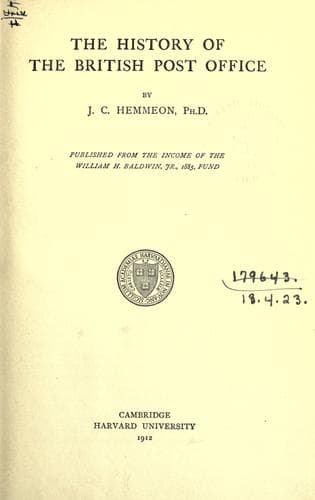
The History of the British Post OfficeHemmeon, Joseph Clarence
History
The History of the British Post Office
Hemmeon, Joseph Clarence
Postal service -- Great Britain -- History
The income received by the Post Office for the fiscal year 1906-07 from
the London and provincial exchanges and trunk-line business was
£908,246, working expenses, £456,459, balance for depreciation,
interest, etc., £451,787, leaving a balance of £19,061 over and above an
estimated amount of £432,726 for depreciation and interest at three per
cent on the capital expenditure. The London exchange, with a gross
income of £330,512, showed a surplus of £25,586 over and above
depreciation fund and interest on capital expenditure, the provincial
exchanges a deficit of £15,758, and the trunk lines a surplus of £9333.
The number of subscribers to the Post Office provincial exchanges
(excluding Glasgow and Brighton) was 10,010. Including the Glasgow
subscribers (11,103) and the Brighton subscribers (1542), the total was
22,655. Arrangements were then being made for local intercommunication
between subscribers of these exchanges and those of the company in the
same places. Hull and Portsmouth were the only towns maintaining
municipal telephonic systems in 1907, Hull having 2128 telephones in use
and Portsmouth 2553. The number of telephones in the London Post Office
telephone service was 41,236, including 425 public call offices. The
agreement of 1905, providing for similar rates in the provinces between
exchanges of the Post Office and those of the company, was followed
after considerable discussion by the announcement of the adoption of a
new scale in May, 1906. The rates are now based on the principle of a
measured service under which each subscriber pays according to the
quality and quantity of the service desired. He may contract for any
number of calls from four hundred upward, and he may share a line with
another subscriber at a reduced rate, or he may rent a line for his own
exclusive use.[841]
[841] _Rep. P. G._, 1905, app., pp. 90-92; 1907, pp. 21-23, 93.
CHAPTER XII
CONCLUSION
The important points in the history of the British Post Office are
necessarily somewhat obscured by the great mass of less important
characteristics which accompanied its development. Organized at the
beginning of the sixteenth century as a means for the conveyance of
state letters, its messengers, by tacit consent, were allowed to carry
the letters of private individuals. The advantage so afforded for the
control of seditious correspondence led to the monopolistic
proclamations of the closing years of the sixteenth and the opening
years of the seventeenth century. Before 1635 the state obtained no
direct revenue for the conveyance of private letters. The messengers or
postmen who were supposed to be paid by the state, derived the larger
part of their income from the postage on these letters and from letting
horses to travellers.
Public-domain text, read in full here on John Shaqi.
Reviews
Reviews
No reviews yet
Be the first to share your thoughts on this work.
Elsewhere in the archive
Join the Discussion
Join the discussion
Sign in to leave a comment or review.
Sign InorCreate an account