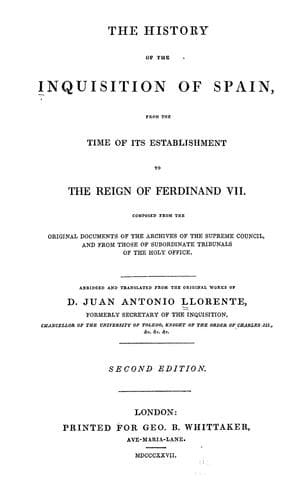
The History of the Inquisition of Spain from the Time of its Establishment to the Reign of Ferdinand VII.Llorente, Juan Antonio
History
The History of the Inquisition of Spain from the Time of its Establishment to the Reign of Ferdinand VII.
Llorente, Juan Antonio
Inquisition -- Spain
The inquisitors took advantage of some expressions which escaped from
the unfortunate woman during the torture, to condemn her as a Judaic
heretic, in order to confiscate her property, which was considerable.
Her memory, her children, and her descendants in the male line were
declared infamous, her bones and effigy were burnt, and her property
confiscated.
The Supreme Council showed a certain degree of moderation in another
affair, before the tribunal of Toledo. Michael Sanchez died in prison,
before his sentence, which was a pecuniary penalty, could be announced
to him: the inquisitors were uncertain if his property was liable for
this penalty; they applied to the council, which replied in the
negative.
I now terminate the history of the remarkable events of the reign of
Charles V. After a reign of forty years, this prince abdicated the crown
in favour of his son Philip II., on the 16th of January, 1556. He did
not long survive his abdication; he died in the convent of the
Jeronimites, at Yuste in the province of Estremadura, on the 21st of
September, 1558, aged fifty-seven years and twenty-one days. He had made
his will at Brussels on the 16th of June, 1554, and a codicil in the
monastery of Yuste, twelve days before his death.
_Religion of Charles V._
Some historians have asserted, that Charles V. adopted, in his retreat,
the opinions of the German protestants; that in his last illness he
confessed himself to Constantine Ponce de la Fuente, his preacher, who
was afterwards known to be a Lutheran; that after his death Philip II.
commissioned the inquisitors to examine the affair, and that the holy
office took possession of the emperor's will, to examine if it contained
anything contrary to the true faith. These statements compel me to enter
into some details which will elucidate this point of history.
To ascertain that the report on the religion of Charles V. is only an
invention of the protestants and the enemies of Philip II., it is
sufficient to read the life of that prince, and that of his father,
composed by Gregorio Leti. Although this historian has made use of the
least authentic documents, in his work, he is entirely silent on this
point. He enters into a minute detail of the life and occupations of
Charles V. in his retreat, and he relates many decisive proofs of his
attachment to the catholic faith, and his zeal in wishing that it might
triumph over the Lutheran heresy; and though no dependance can be placed
on what he says concerning the conversations of the emperor with the
Archbishop Carranza, (since there is nothing relating to them in his
trial, which I have read,) yet it must be confessed that his recital is
otherwise very exact.
Public-domain text, read in full here on John Shaqi.
Reviews
Reviews
No reviews yet
Be the first to share your thoughts on this work.
Elsewhere in the archive
Join the Discussion
Join the discussion
Sign in to leave a comment or review.
Sign InorCreate an account