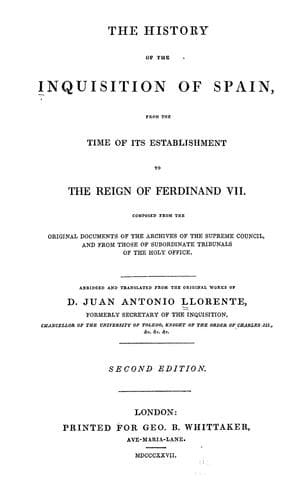
The History of the Inquisition of Spain from the Time of its Establishment to the Reign of Ferdinand VII.Llorente, Juan Antonio
History
The History of the Inquisition of Spain from the Time of its Establishment to the Reign of Ferdinand VII.
Llorente, Juan Antonio
Inquisition -- Spain
my will_, that he may fulfil his duty as a prince, and render himself
worthy that the Lord should make his reign prosperous, conduct his
affairs, and protect him against his enemies, to my consolation[13]."
I have already stated, that no dependance can be placed on the account
given by Gregorio Leti of the conversations of the emperor with Don
Bartholomew Carranza de Miranda, archbishop of Toledo. It is certain
that the emperor had a great esteem for Carranza, which induced him to
give him the bishopric of Cusco in America, in 1542, and of the Canaries
in 1549; to send him as theologian of the emperor to the council of
Trent, in 1545 and 1551; and to London with his son Philip II., King of
Naples and England, in 1554, to preach against the Lutherans.
Nevertheless, when he was informed, in his retreat at Yuste, that
Carranza had accepted the archbishopric of Toledo, to which King Philip
had appointed him, he began to feel less esteem for him, because he did
not know that Carranza had refused that dignity, and named three persons
whom he considered more worthy to occupy it. Philip was not only
displeased at this refusal, but he commanded him to obey the will of his
sovereign, and wrote to the Pope, who supported his order by a
particular brief addressed to Br. Bartholomew.
Charles V., at this period, had Br. Juan de Regla, a Jeronimite, and a
learned theologian, for his confessor. He had assisted at the Council of
Trent with Carranza, whom he always treated as an enemy, because he was
jealous of his great reputation. I shall hereafter prove the disposition
of Juan de Regla towards Carranza; at present I shall only show that he
had great part in his disgrace with the emperor, for being suspected of
professing the same doctrines as Egidius, Constantine, Cazalla, and
others. Regla became more fanatic than charitable, during the
persecution which he suffered from the Inquisition of Saragossa, when he
was prior of the Convent of Santa Fè; he was condemned to abjure
eighteen Lutheran propositions, of which the inquisitors declared him to
be suspected. The emperor was also informed, through the private
correspondence of his children, that the Inquisition was occupied in
preparing the trial of the archbishop for heresy, when he came to visit
him in his last illness; and his presence was so disagreeable, that,
instead of conversing with him, as Leti affirms, he did not speak one
word. Sandoval, with more probability, thus expresses himself: "This
evening the archbishop of Toledo, Carranza, arrived, but he could not
see the emperor. This prince had waited for him with much impatience
since he had quitted England, because he wished to have an explanation
on certain things which had been reported of him, and seemed to show
that his faith was suspected; for that of the prince was extremely
lively, and anything which appeared contrary to sound doctrine gave him
great pain. The archbishop returned on another day; the emperor who
Public-domain text, read in full here on John Shaqi.
Reviews
Reviews
No reviews yet
Be the first to share your thoughts on this work.
Elsewhere in the archive
Join the Discussion
Join the discussion
Sign in to leave a comment or review.
Sign InorCreate an account