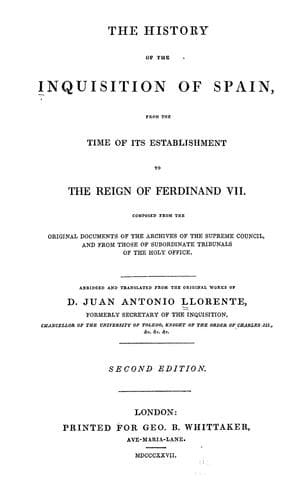
The History of the Inquisition of Spain from the Time of its Establishment to the Reign of Ferdinand VII.Llorente, Juan Antonio
History
The History of the Inquisition of Spain from the Time of its Establishment to the Reign of Ferdinand VII.
Llorente, Juan Antonio
Inquisition -- Spain
In 1570 Philip II. appointed an Inquisition at Mexico, and in 1571
established three tribunals for all America; one at Lima, one at Mexico,
and the other at Carthagena, assigning to each the extent of territory
which they were to possess, and subjecting them to the authority of the
inquisitor-general and the Supreme Council.
The first _auto-da-fé_ in Mexico took place in 1574; it was celebrated
with so much pomp and splendour, that eye-witnesses have declared that
it could only be compared to that of Valladolid in 1559, at which Philip
II. and the royal family attended. A Frenchman and an Englishman were
burnt as impenitent Lutherans; eighty persons were reconciled, and
subjected to different penances. The Inquisition of Carthagena was not
established at this period; it was founded in 1610 by Philip III.
The great fleet of the Catholic league against the Emperor of
Constantinople, which gained the famous battle of Lepanto, inspired
Philip II. with the project of creating an Inquisition for heretics who
might be found in ships. As the authority of the inquisitor-general did
not extend beyond the dominions of the King of Spain, it was considered
necessary to apply to the Pope, who in 1571 granted the brief, which was
demanded, authorizing the inquisitor-general to create the new tribunal,
and appoint judges and officers. It was first known by the name of the
_Inquisition of the Galleys_, but it was afterwards called the
_Inquisition of the Fleets and Armies_; it existed but for a short
period, as it was found to impede the progress of navigation.
The Inquisition was unknown in Galicia for more than a century before
this period. This province formed part of the district subject to the
holy office of old Castile and the kingdom of Leon; it had escaped this
scourge, but at last Philip II. resolved that it should have an
Inquisition to superintend the sea-ports, in order to prevent the
introduction of pernicious books, and the entrance of persons who would
teach the doctrines of the Protestants. The royal ordinance which
established the Inquisition in Galicia was expedited in 1574, and the
tribunal was organised in the same year.
_Disputes with the Inquisition of Portugal._
The establishment of the power of Philip II. in Portugal, after the
death of the Cardinal King Don Henry, who had occupied the throne until
1580, gave that prince another opportunity of signalizing his zeal for
the Inquisition. I have already indicated the period of its institution,
and the attendant circumstances[18]. Don Henry was inquisitor-general
from 1539 to 1578, when he succeeded to the crown of Portugal, after the
death of his nephew Don Sebastian. He bestowed the archbishopric of
Lisbon, which he occupied at the time of his accession, on Don George
Almeida, and likewise appointed him the third inquisitor-general of the
kingdom.
Public-domain text, read in full here on John Shaqi.
Reviews
Reviews
No reviews yet
Be the first to share your thoughts on this work.
Elsewhere in the archive
Join the Discussion
Join the discussion
Sign in to leave a comment or review.
Sign InorCreate an account