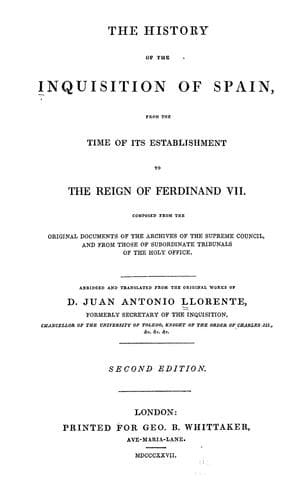
The History of the Inquisition of Spain from the Time of its Establishment to the Reign of Ferdinand VII.Llorente, Juan Antonio
History
The History of the Inquisition of Spain from the Time of its Establishment to the Reign of Ferdinand VII.
Llorente, Juan Antonio
Inquisition -- Spain
The inquisitor-general, Don Henry, died in 1580. The crown of Portugal
then descended to Philip II., as being the son of the Empress Isabella,
the sister of John III., King of Portugal. As the office of
grand-inquisitor was vacant, he wished to suppress it, and place
Portugal under the dominion of that of Spain. He represented to the Pope
that there would be more unity in the proceedings: but this attempt was
unsuccessful, as he had only been acknowledged king, on condition that
the crown should continue independent of that of Spain.
When the Duke of Braganza was proclaimed King of Portugal in the reign
of Philip IV., Don Francis de Castro grand-inquisitor, and Don John de
Vasconcellas, a member of the council of the Inquisition, remained
faithful to the King of Spain. The new sovereign (who had taken the name
of John IV.) wished to increase his party. Influenced by the advice of
England, which had favoured the insurrection, he resolved to restore to
the Jews the liberty which they enjoyed before the establishment of the
Inquisition; but he was opposed by the two inquisitors above mentioned.
The council even condemned a decision of the university of Paris, in
which it was said that the king could appoint and consecrate bishops
without bulls from Rome, if Pope Innocent X. refused to grant them. John
IV. threatened the inquisitors with imprisonment, and even with death,
but they were ready to suffer anything rather than consent to the
emancipation of the Jews. Don Francis de Castro died, and it was
necessary to appoint another inquisitor-general; but the bulls of
confirmation were not less difficult to obtain than those for bishops,
as the Popes, Urban VIII., Innocent X., and Alexander VII., avoided
declaring in favour of either the King of Spain or the Duke of Braganza.
At last Portugal triumphed over the efforts of Spain, and the
Inquisitions of the two kingdoms seldom had any communication.
That I may not pass over any event tending to prove the attachment of
Philip II. for the Inquisition, I shall here mention a project for a
military order of the holy office, which would never have been
conceived, if the partiality of the monarch for this tribunal had not
been generally known.
Public-domain text, read in full here on John Shaqi.
Reviews
Reviews
No reviews yet
Be the first to share your thoughts on this work.
Elsewhere in the archive
Join the Discussion
Join the discussion
Sign in to leave a comment or review.
Sign InorCreate an account