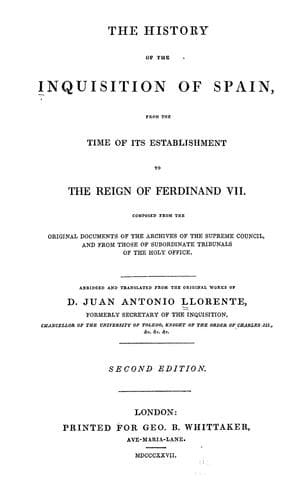
The History of the Inquisition of Spain from the Time of its Establishment to the Reign of Ferdinand VII.Llorente, Juan Antonio
History
The History of the Inquisition of Spain from the Time of its Establishment to the Reign of Ferdinand VII.
Llorente, Juan Antonio
Inquisition -- Spain
Marina de Saavedra, the widow of Juan Cisneros de Soto, a distinguished
gentleman, Isabella Minguez, a servant of Donna Beatrice Cazalla, and
Antonio Minguez, the brother of Isabella, suffered the same punishment.
Anthony Wasor, an Englishman, servant to Don Louis de Roxas, was
condemned to wear the _San-benito_, to lose his property, and be
confined in a convent for one year.
Daniel de la Quadra lost his liberty and property, and took the
perpetual _San-benito_, as a Lutheran.
The sermon on the faith was preached by the celebrated Melchior Cano,
after all the assembly had witnessed a scandalous transaction. When the
court and all the other attendants had taken their places, Don Francis
Baca, Inquisitor of Valladolid, advanced towards the Prince of Asturias,
Don Carlos, and his aunt, the princess Juana, to demand and receive from
them an oath to maintain and defend the Inquisition, and to reveal to it
all that might have been said against the faith by any person within
their knowledge. It had been decreed at the establishment of the
Inquisition, that the magistrate who presided at an _auto-da-fé_ should
take a similar oath, but sovereigns cannot be considered as magistrates.
Don Carlos and his aunt took the oath, but subsequent events show how
much he was displeased at the boldness of this inquisitor: he was then
aged fourteen years.
_Second Auto-da-fé._
The second _Auto-da-fé_ of Valladolid took place on the 8th of October,
in the same year, 1559; it was still more splendid than the first, on
account of the presence of Philip II. The inquisitors had waited his
return from the Low Countries, to do him honour in this grand festival.
Thirteen persons, with a corpse and an effigy, were burnt, and sixteen
admitted to reconciliation. The king was accompanied by his son, his
sister, the Prince of Parma, three ambassadors from France, the
Archbishop of Seville, the Bishops of Palencia and Zamora, and other
bishops elect; there were also present, the constable and admiral, the
Dukes de Naxara and d'Arcos, the Marquis de Denia, afterwards Duke of
Lerma, the Marquis d'Astorga, and the Count de Ureña, afterwards Duke of
Ossuna, the Count de Benavente, the Count de Buendia, the last
grand-master of the military order of Montesa, Don Louis Borgia, the
Grand Prior of Castile and Leon, a knight of the order of St. John of
Jerusalem, Don Antonio de Toledo, son and brother to the Dukes of Alva;
several other grandees of Spain, not named in the verbal-process of this
execution, and many persons of lower rank: the Countess de Ribadabia,
and other ladies of distinction, besides the councils, the tribunals,
and other authorities.
The sermon on the faith was preached by the Bishop of Cuença: the
Bishops of Palencia and Zamora degraded the condemned priests; and the
inquisitor-general, the Archbishop of Seville, demanded and received
from the king the same oath which had been administered to Don Carlos.
The condemned persons were:--
Public-domain text, read in full here on John Shaqi.
Reviews
Reviews
No reviews yet
Be the first to share your thoughts on this work.
Elsewhere in the archive
Join the Discussion
Join the discussion
Sign in to leave a comment or review.
Sign InorCreate an account