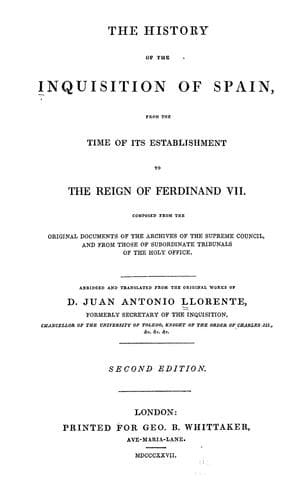
The History of the Inquisition of Spain from the Time of its Establishment to the Reign of Ferdinand VII.Llorente, Juan Antonio
History
The History of the Inquisition of Spain from the Time of its Establishment to the Reign of Ferdinand VII.
Llorente, Juan Antonio
Inquisition -- Spain
Among the prohibited books, were found several writings by Constantine
Ponce de Fuente, which treated of the true church according to the
principles of the Lutherans, and proved in their manner, that this
church was not that of the _papists_: he also discussed in them several
other points on which the Lutherans differed from the Catholics.
Constantine could not deny these papers, as they were in his own
hand-writing; he confessed that they contained the profession of his
faith, but refused to name his accomplices and disciples. The
inquisitors, instead of decreeing the torture, plunged him into a deep,
humid, and obscure dungeon, where the air, impregnated with the most
dangerous miasma, soon altered his health. Overcome by this persecution,
he exclaimed, "_My God, were there no Scythians or cannibals into whose
hands to deliver me, rather than to let me fall into the power of these
barbarians!_" This situation could not last long; Constantine fell sick,
and died of a dysentery: it was reported, when the _auto-da-fé_ was
celebrated, that he had killed himself to avoid his punishment. His
trial was as celebrated as his person. The inquisitors caused the
_merits_ or charges against him to be read in a pulpit close to their
seats, where the people could not hear them; the Corregidor Calderon
remarked the circumstance twice, and they were obliged to begin it again
where those of the other trials were read. Constantine had published the
first part of a catechism; the second was not printed. The following
works of Constantine were inserted in the prohibitory Index, published
in 1559, by Don Ferdinand Valdés:--An Abridgment of the Christian
Doctrine; a Dialogue on the same subject, between a Master and his
Disciple; The Confession of a Sinner to Jesus Christ; A Christian
Catechism; An Exposition of the Psalm, _Beatus qui non abiit in concilio
impiorum_. Alphonso de Ulloa, in his Life of Charles V., gives the
highest praise to the works of Constantine, particularly his Treatise on
the Christian Doctrine, which was translated into Italian[22]. The
effigy of Contantine was not like those of the other condemned persons
(which were an unformed mass surmounted by a head); it was an entire
figure with the arms spread, as Constantine was accustomed to do when
preaching, and was clothed in garments which appeared to have belonged
to him. After the _auto-da-fé_, this figure was taken back to the Holy
Office, and a common effigy was burnt with the bones of the condemned.
Public-domain text, read in full here on John Shaqi.
Reviews
Reviews
No reviews yet
Be the first to share your thoughts on this work.
Elsewhere in the archive
Join the Discussion
Join the discussion
Sign in to leave a comment or review.
Sign InorCreate an account