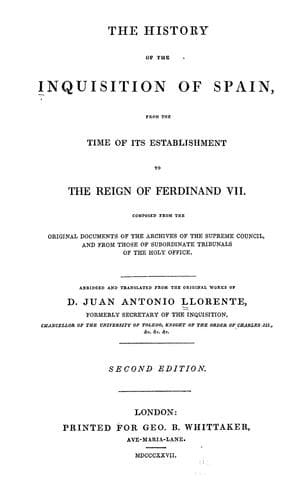
The History of the Inquisition of Spain from the Time of its Establishment to the Reign of Ferdinand VII.Llorente, Juan Antonio
History
The History of the Inquisition of Spain from the Time of its Establishment to the Reign of Ferdinand VII.
Llorente, Juan Antonio
Inquisition -- Spain
Nicholas Burton, born in England, was condemned at an impenitent
Lutheran heretic. It is impossible to justify the conduct of the
inquisitors to this Englishman, and several other foreigners who had not
settled in Spain, and were merely returning to their respective
countries after having transacted their commercial affairs. This man
came to Spain in a vessel laden with merchandise, which, he said, was
all his own property, but of which some part belonged to John Fronton,
who was reconciled in this _auto-da-fé_. Burton refused to abjure, and
was burnt alive; the inquisitors seized his vessel and its freight, thus
proving that avarice was the principal motive of the Inquisition. The
inquisitors were guilty of a great cruelty in this instance, and the
commerce of Spain would perhaps have been destroyed, if the violence
committed against Burton, and some others, had not been protested
against by the different powers, which induced Philip IV. to prohibit
the inquisitors from molesting foreign merchants and travellers, if they
did not attempt to promulgate heretical opinions; but the inquisitors
eluded this order, by pretending that they brought prohibited books into
the kingdom, or spoke in favour of heresy.
Gonzalez de Montes speaks of the arrival in Spain of a very rich
stranger, named Rehukin, whose vessel was finer and better built than
any that had ever appeared at San-Lucar de Barrameda. The Inquisition
arrested him as an heretic, and confiscated his property; the merchant
proved that the vessel did not belong to him, and that it could not be
included in the confiscation; but his efforts to recover it were
useless.
Two other foreigners shared the fate of Burton. One was an Englishman
named William Brook, born at Sarum, and a sailor; the other was a
Frenchman of Bayonne, named Fabianne, whose trade required his presence
in Spain.
The _Beata_ protected by Francis Zafra, who had recovered her senses,
but persisted in her heresy, was burnt in this _auto-da-fé_, with five
women of her family. Thirty-four persons were condemned to penances. The
most remarkable instances were:--
Public-domain text, read in full here on John Shaqi.
Reviews
Reviews
No reviews yet
Be the first to share your thoughts on this work.
Elsewhere in the archive
Join the Discussion
Join the discussion
Sign in to leave a comment or review.
Sign InorCreate an account