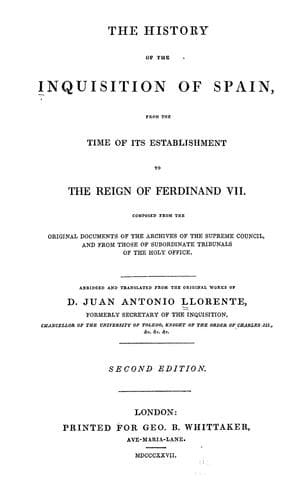
The History of the Inquisition of Spain from the Time of its Establishment to the Reign of Ferdinand VII.Llorente, Juan Antonio
History
The History of the Inquisition of Spain from the Time of its Establishment to the Reign of Ferdinand VII.
Llorente, Juan Antonio
Inquisition -- Spain
_Preamble._ "We, Don Ferdinand Valdés, by the grace of God, Archbishop
of Seville, apostolical inquisitor-general against heresy and apostacy
in all the kingdoms and domains of his majesty, &c.; we inform you,
venerable apostolical inquisitors, that we understand, that although it
has been provided by the ordinances of the holy office, that the same
manner of proceeding should be exactly followed in all the Inquisitions,
there are, nevertheless, some tribunals where this measure has not
been, and is not well observed. In order to prevent any difference for
the future, in the conduct of the tribunals, and the forms which should
be followed, it has been resolved, after communicating and consulting
with the council of the general Inquisition, that the following order
shall be observed by the tribunals of the holy office:--
1st. When the inquisitors admit an information, which shows that
propositions have been advanced which ought to be denounced to the holy
office, they must consult theologians of learning and integrity, and
capable of qualifying the said propositions; they shall give their
opinion in writing, accompanied by their signature.
2nd. If it is certain from the opinion of the theologians that the
object of their examination is a matter of faith, or if it is apparent
without consulting them, and the denounced fact is sufficiently proved,
the procurator-fiscal shall denounce the author of it, and the
individuals implicated, if there are any, and shall require that they be
arrested[23].
3rd. The inquisitors shall be assembled to decide if imprisonment should
be decreed; in doubtful cases, they shall summon consultors, if they
find it necessary[24].
4th. When the proof is not sufficient to cause the arrest of the
denounced person, the inquisitor shall not cite him to appear, or
subject him to any examination, because experience has shown, that an
heretic who is at liberty will not confess, and this measure only makes
him more reserved and attentive in avoiding everything that may increase
the suspicions or the proofs brought against him.
5th. If the inquisitors are not unanimous in decreeing an arrest, the
writings of the trial shall be sent to the council, and this must
likewise take place even when they are unanimous in their decisions, if
the individuals to be arrested are persons of quality and consideration.
Public-domain text, read in full here on John Shaqi.
Reviews
Reviews
No reviews yet
Be the first to share your thoughts on this work.
Elsewhere in the archive
Join the Discussion
Join the discussion
Sign in to leave a comment or review.
Sign InorCreate an account