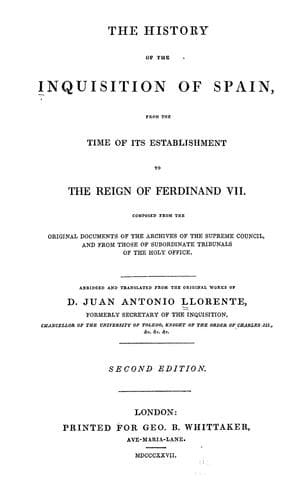
The History of the Inquisition of Spain from the Time of its Establishment to the Reign of Ferdinand VII.Llorente, Juan Antonio
History
The History of the Inquisition of Spain from the Time of its Establishment to the Reign of Ferdinand VII.
Llorente, Juan Antonio
Inquisition -- Spain
15th. When the preceding ceremony has passed, the accused shall be
required to give an abridged history of his life, mentioning those towns
where he has made a considerable stay, the motives of his sojourn, the
persons he associated with, the friends he acquired, his studies, the
masters he studied under, the period when he began them, and the time
that he continued them; if he had been out of Spain, at what time and
with whom he had quitted the country, and how long he had been absent.
He shall be asked if he is instructed in the truths of the Christian
religion, and shall be required to repeat the _Pater-noster_, the _Ave
Maria_, and the _Credo_. He shall be asked if he has confessed himself,
and to what confessors. When he has given an account of all these
things, he shall be asked if he knows or suspects the cause of his
arrest, and his reply shall regulate the questions put to him
afterwards. The inquisitors shall avoid interrupting the accused while
he is speaking, and shall allow him to express himself freely while the
recorder writes down his declarations, unless they are foreign to the
trial. They shall ask all necessary questions, but shall avoid fatiguing
him by examining him on subjects not relating to the trial, unless he
gives occasion for it by his replies.
16th. It is proper that the inquisitors should always suspect that they
have been deceived by the witnesses, and that they shall be so by the
accused, and that they should not take either side; for, if they adopt
an opinion too soon, they will not be able to act with that impartiality
which is suitable to their station, and on the contrary will be liable
to fall into error.
17th. The inquisitors shall not speak to the accused during the
audience, or at other times, of any affair not relating to his own. The
recorder shall write down the questions and replies; and, after the
audience, he shall read it to the accused, that he may sign it. If he
wishes to add, retrench, alter, or elucidate, any article, the recorder
shall write after his dictation, without suppressing or certifying the
articles already written.
18th. The fiscal shall present his act of accusation within the time
prescribed by the ordinances; he shall accuse the prisoner of being an
heretic in general terms, and afterwards mention, in particular, the
facts and propositions of which he is charged. The inquisitors have not
the right of punishing an accused person for crimes which do not relate
to matters of faith; but if the preparatory instruction mentions any,
the fiscal shall make it the object of an accusation, because this
circumstance, and that of his general good or bad conduct, assists in
determining the degree of credence to be given to his replies, and
serves for other purposes in his trial.
Public-domain text, read in full here on John Shaqi.
Reviews
Reviews
No reviews yet
Be the first to share your thoughts on this work.
Elsewhere in the archive
Join the Discussion
Join the discussion
Sign in to leave a comment or review.
Sign InorCreate an account