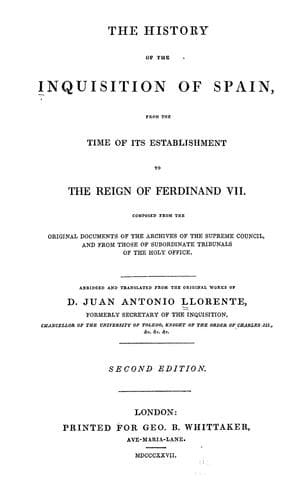
The History of the Inquisition of Spain from the Time of its Establishment to the Reign of Ferdinand VII.Llorente, Juan Antonio
History
The History of the Inquisition of Spain from the Time of its Establishment to the Reign of Ferdinand VII.
Llorente, Juan Antonio
Inquisition -- Spain
33rd. If an accused, who has made declarations in several sittings,
reveals crimes committed by persons whom he named, and afterwards makes
new declarations, only cites these persons in a vague and general
manner, employing for example, the words, _all those whom I have named_,
or a similar expression; these accusations cannot be brought against any
accused person, as they do not apply in a direct manner; this must
oblige the inquisitors to pay attention to the prisoner who speaks of
different individuals, and cause him to name them one after the other,
and afterwards to state the facts or words which he imputes to them.
34th. Although the accused has denied the charges, the publication of
the depositions must be read to him, that he may not call in question
the regularity of the proceedings of the tribunal which has arrested
him, and that the judges may rely with more confidence on the law when
they pass sentence; for this discretionary power exists only if the
accused is convicted and confesses himself guilty; otherwise the charges
brought against him by the witnesses, whose declarations have not been
mentioned to him, cannot be of any value, particularly in a trial of
this kind, when the accused is not present at the oath of the witnesses.
35th. When the accused has replied to the publication of the
depositions, he shall be permitted to consult with his advocate, in the
presence of an inquisitor and the recorder, that he may prepare his
defence. The recorder shall write down the particulars of the conference
which he considers worthy of attention. Neither the inquisitor nor
recorder, still less the advocate, shall remain alone with the accused.
It shall be the same with all other persons, except the gaoler or his
deputy. It is sometimes eligible that learned and pious persons should
visit the accused, to exhort them to confess what they obstinately deny,
though they have been convicted. These interviews can only take place in
the presence of the recorder or an inquisitor. Procurators shall not be
permitted to be appointed for the prisoner, though the _old
instructions_ have established this measure, because experience has
shown that great inconvenience arises from it[26]; besides which, the
accused derives little advantage from it[27]. If any unforeseen
circumstance renders this measure necessary, the advocate may be
appointed to fill the office.
Public-domain text, read in full here on John Shaqi.
Reviews
Reviews
No reviews yet
Be the first to share your thoughts on this work.
Elsewhere in the archive
Join the Discussion
Join the discussion
Sign in to leave a comment or review.
Sign InorCreate an account