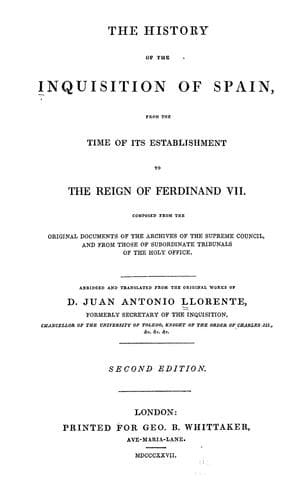
The History of the Inquisition of Spain from the Time of its Establishment to the Reign of Ferdinand VII.Llorente, Juan Antonio
History
The History of the Inquisition of Spain from the Time of its Establishment to the Reign of Ferdinand VII.
Llorente, Juan Antonio
Inquisition -- Spain
72nd. The witnesses in a trial shall not be confronted, because
experience has shown that this measure is useless and inconvenient,
independently of the infringement of the law of secrecy which is the
result.
73rd. When an inquisitor visits the towns of the district of his
tribunal, he shall not undertake any trial for heresy, or arrest any
denounced person, but he shall receive the declarations and send them to
the tribunal. Yet if it is the case of a person whose flight may be
apprehended, he may be arrested and sent to the prisons of the holy
office; the inquisitor may also decide upon affairs of small
consequence, such as heretical blasphemies, which may be judged without
arresting the parties. The inquisitor shall not exercise this authority
without being empowered by the ordinary.
74th. In the definitive sentence pronounced against an individual
declared guilty of heresy, and condemned to be deprived of his property,
the period when he first fell into heresy shall be indicated, because
this knowledge may be useful to the steward of the confiscations; it
shall likewise be mentioned if this declaration is founded on the
confession of the accused, on the depositions of the witnesses, or on
both. If this formality is omitted, and the steward demands that it
shall be fulfilled, the inquisitors shall comply; if it cannot be done
by all together, it shall at least be executed by one of them, or the
consultors.
75th. An account shall be given by the gaoler of the common and daily
nourishment of each prisoner, according to the price of the eatables; if
there is in the prison a person of quality, or who is rich and has
several domestics, he shall be supplied with the quantity of food which
he requires, but only on condition that the remnants be distributed to
the poor, and not given to the gaoler.
76th. If the prisoner has a wife or children, and they require to be
maintained from his sequestrated property, a certain sum for each day
shall be allowed them, proportioned to their number, age, quality, and
the state of their health, as well as to the extent and value of these
possessions. If any of the children exercise any profession, and can
thus provide for themselves, they shall not receive any part of the
allowance.
77th. When any trials are terminated and sentences passed, the
inquisitors shall fix the day for the celebration of an _auto-da-fé_.
They give notice of it to the ecclesiastical chapter and the
municipality of the town, and likewise to the president and the judges
of the royal court, if there is one, that they may assemble with the
tribunal, and accompany it to the ceremony according to custom. They
shall use proper means that the execution of those who are to be
_relaxed_ shall take place before night, in order to prevent accidents.
Public-domain text, read in full here on John Shaqi.
Reviews
Reviews
No reviews yet
Be the first to share your thoughts on this work.
Elsewhere in the archive
Join the Discussion
Join the discussion
Sign in to leave a comment or review.
Sign InorCreate an account