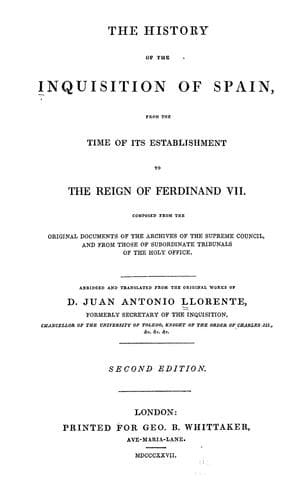
The History of the Inquisition of Spain from the Time of its Establishment to the Reign of Ferdinand VII.Llorente, Juan Antonio
History
The History of the Inquisition of Spain from the Time of its Establishment to the Reign of Ferdinand VII.
Llorente, Juan Antonio
Inquisition -- Spain
Lastly, when his confessions did not produce the effect he wished, he
said, that he really believed in what was preached in the synagogue, and
persisted in this belief for a year; but that he had not confessed,
because he thought there was no proof of his heresy in the depositions
of the witnesses. The inquisitors decreed that Melchior should not
appear in the _auto-da-fé_ of this day, and that they would consult on
the proper measures to be taken.
On the 14th of December, Melchior ratified his propositions of the 9th,
but on the condition that all that had passed should not separate him
from the Catholic communion, or cause him to be considered as a Judaic
heretic. On the 18th he desired another audience, and again confessed
that he believed in the Law of Moses. Yet on the 29th of June, 1566, he
declared that the Holy Scriptures were read in the assembly, that he
believed part of what he heard, and had consulted a priest on the
subject; that the priest told him it ought to be held in contempt, and
that this decision had regulated his subsequent conduct.
On the 6th of May, 1566, the tribunal assembled to decide whether the
definitive sentence pronounced against Melchior should be executed. Two
of the consultors voted in the affirmative; the inquisitors, the
ordinary, and the other consultors agreed that Melchior had confessed
enough to entitle him to reconciliation. In an audience on the 28th of
May, the accused again asked pardon, alleging that he had only believed
what he heard, until he was undeceived by the priest. On the 30th he
declared that he thought all he had heard necessary to salvation.
In the October following, he was again admitted to an audience, where he
spoke against the inquisitor, who had received his confession on the day
of the _auto-da-fé_ (this was Don Jerome Manrique); he complained of the
ill treatment he had been subjected to, in order to obtain new
declarations. He acknowledged that his confessions on that day were
true, but added that the presence of two inquisitors was necessary to
prevent the abuse of authority which took place in his case.
The fiscal protested against the act of reconciliation granted to
Melchior on the 6th of May, 1566, and demanded that the sentence of
_relaxation_ pronounced on the 8th of October, 1565, should be executed,
because the accused had shown no signs of true repentance, and would not
fail to seduce others into heresy if he was pardoned. The inquisitors
consulted the Supreme Council, which decided that the prisoner should be
examined again before the ordinary and consultors, and the affair
submitted to the Council. The sentence was pronounced on the 9th of May,
1567; three of the judges voted for the _relaxation_, and two for the
_reconciliation_ of the accused.
Public-domain text, read in full here on John Shaqi.
Reviews
Reviews
No reviews yet
Be the first to share your thoughts on this work.
Elsewhere in the archive
Join the Discussion
Join the discussion
Sign in to leave a comment or review.
Sign InorCreate an account