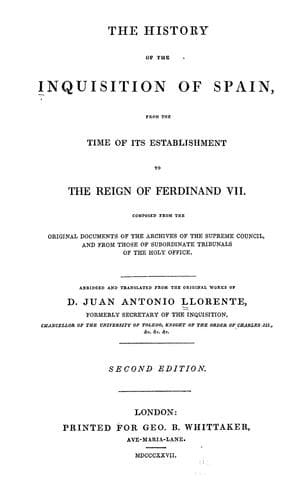
The History of the Inquisition of Spain from the Time of its Establishment to the Reign of Ferdinand VII.Llorente, Juan Antonio
History
The History of the Inquisition of Spain from the Time of its Establishment to the Reign of Ferdinand VII.
Llorente, Juan Antonio
Inquisition -- Spain
_Cespedes_ (Doctor Paul de), born at Cordova, prebendary of the
Cathedral of that city, and residing at Rome. The Inquisition of
Valladolid tried him in 1560, for some letters which he had written to
Don Bartholomew Carranza, archbishop of Toledo, and which were found
among the papers of that prelate, with the copies of his replies. In one
of these letters dated from Rome, on the 17th of February, 1559, he
gives him an account of his proceedings in his favour, and allowed
himself to speak ill of the inquisitor-general and the Inquisition of
Spain. Cespedes was a great literati, a great painter, and poet, and a
very clever modeller in wax: he composed a poem, in stanzas of eight
verses, on _Repentance_. Juan de Verzosa and Francis Pacheco (both
mentioned with approbation by Nicholas Antonio) have highly praised this
poem. Cespedes continued to reside at Rome, and thus the inquisitors of
Valladolid could not execute their projects of vengeance.
_Chumacero_ (Don Juan de). See the following Chapter.
_Clavijo y Faxardo_ (Don Joseph de), principal director of the museum of
natural history at Madrid, and a learned man, who had a great taste for
science. The Inquisition of the _Court_ tried him on the suspicion that
he had adopted the antichristian principles of modern philosophy. He was
confined to the city of Madrid, which was fortunate for him, as he thus
preserved his honour and his office; he appeared privately before the
tribunal, and was only condemned to private penances; he also made his
abjuration, _de levi_, with closed doors, in the hall of the tribunal.
It is true that the proofs against him were weak, and he gave to his
propositions an air of Catholicism. He had lived for some time in Paris,
where he had been intimate with Buffon and Voltaire. He edited a
journal, called _The Thinker_. M. Langle, in his _Travels in Spain_,
says, that this work is without merit; if this author judged truly, it
would, perhaps, be the only truth in his book. Clavijo was appointed
editor of the _Mercury_, by the government, he also published a
translation of "Buffon's Natural History," with notes. As this book is
written with great purity of style, and without gallicisms, it is an
important acquisition to those who seek a work rich in the beauties of
the Spanish language. The Count d'Aranda also gave him the direction of
a company of tragic actors: Clavijo endeavoured to fulfil the intention
of the minister, but religious fanaticism arrested the progress of the
design.
_Clement_ (Don Joseph), bishop of Barcelona. See the following Chapter.
Public-domain text, read in full here on John Shaqi.
Reviews
Reviews
No reviews yet
Be the first to share your thoughts on this work.
Elsewhere in the archive
Join the Discussion
Join the discussion
Sign in to leave a comment or review.
Sign InorCreate an account