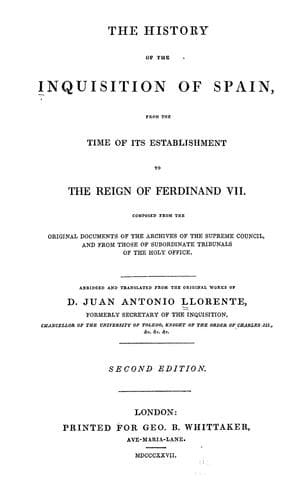
The History of the Inquisition of Spain from the Time of its Establishment to the Reign of Ferdinand VII.Llorente, Juan Antonio
History
The History of the Inquisition of Spain from the Time of its Establishment to the Reign of Ferdinand VII.
Llorente, Juan Antonio
Inquisition -- Spain
_Mariana_ (Juan de), Jesuit. He was a natural son of Juan Martinez de
Mariana, afterwards canon and dean of the college of Talavera de la
Reyna, where Mariana was born in 1536. When he had finished his studies
at Alcala, and had become well skilled in the oriental tongues and in
theology, he quitted Spain to travel in foreign countries: he professed
theology in Rome, Sicily, and at Paris. When he returned he wrote his
history of Spain, and was often consulted by the government in affairs
of a difficult and delicate nature. He was chosen as an arbitrator in
the great question concerning the royal Polyglott Bible of Antwerp, and,
contrary to the wishes and intrigues of his brethren, he decided in
favour of Benedict Arias Montanus. In 1583 he was commissioned to form
an Index, in which he left out the work of St. Francis Borgia. The
Jesuits, who are not accustomed to forgive such conduct, did not
afterwards treat him with the consideration to which he was entitled. He
proved the vices of the government of their society in a work called,
_Of the Maladies of the Society of Jesus_. This work was not published
till after the death of the author; but his brethren were acquainted
with some parts of it, which increased their hatred towards him. In 1599
he published and dedicated to Philip III. his treatise _de Rege et Regis
institutione_, which was burnt at Paris by the common executioner. He
also published in 1609, seven treatises in one folio volume, one of them
is on the _Exchange of Money_, and another on _Death and Immortality_.
These works exposed him to prosecutions from the government and the holy
office. I have read his defence, and the doctrine he professed is so
pure and solid, that I am persuaded it would be favourably received if
it was printed. The sentence of the king was more lenient than he could
have expected, after having, in his dedication to that monarch, shown
himself the advocate of the _regicide_, disguised under the name of the
_tyrannicide_. He did not escape so well from the inquisitors: they made
some retrenchments in his work on the _Exchange of Money_, and it was
prohibited until he had been punished. A penance was imposed on the
author, and he was confined a long time in his college. He died at
Toledo in 1623, at the age of eighty-seven. Nicholas Antonio mentions
other works by the same author. In the _Dictionnaire_ of Peignot there
are some details which might be interesting to a literary person.
_Medina_ (Fray Michel de). See Chapter 29.
_Meneses_ (Fray Philip de), Dominican, and professor of theology at
Alcala de Henares; he gave a favourable opinion of the Catechism of
Carranza. The Inquisition of Toledo received from that of Valladolid the
writings of his trial, summoned Fray Philip, and condemned him to the
same punishment as Fray Juan de Ludeña.
Public-domain text, read in full here on John Shaqi.
Reviews
Reviews
No reviews yet
Be the first to share your thoughts on this work.
Elsewhere in the archive
Join the Discussion
Join the discussion
Sign in to leave a comment or review.
Sign InorCreate an account