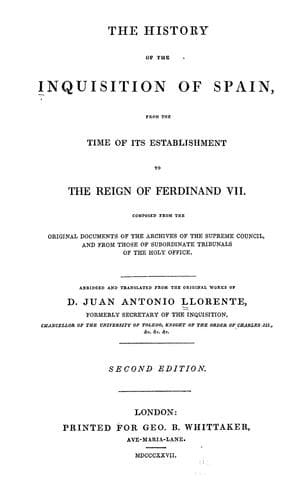
The History of the Inquisition of Spain from the Time of its Establishment to the Reign of Ferdinand VII.Llorente, Juan Antonio
History
The History of the Inquisition of Spain from the Time of its Establishment to the Reign of Ferdinand VII.
Llorente, Juan Antonio
Inquisition -- Spain
_Valdés_ (Juan de), author of some works which are mentioned by Nicolas
Antonio; one of them, the _Commentary on the First Epistle of St. Paul
to the Corinthians_, is prohibited in the Index. He was tried on account
of this treatise and another, which was found among the papers of
Carranza, and which was at first supposed to be his composition; this
work is called _Thoughts on the Interpretations of the Holy Scriptures_.
Valdés also composed another called _Acharo_; all these works were
noted as being Lutheran, and the author was declared to be a _formal
heretic_. Valdés left Spain, and thus escaped imprisonment. In 1559,
Fray Louis de la Cruz, a prisoner in the Inquisition of Valladolid,
declared that Valdés was living at Naples; that his _Thoughts_, &c. had
been sent twenty years before to Carranza, in the form of a letter, but
that it had its origin in the _Christian Institutions_ of Thaulero. Fray
Dominic de Roxas (another prisoner in the Inquisition) spoke of this
Valdés as if he was the secretary of Charles V.; if that was the case,
he must be called _Juan Alonzo de Valdés_. Nicolas Antonio mentions him
as a different person in his _Bibliothèque_.
_Vergara_ (Juan de). See Chapter 14.
_Vicente_ (Doctor Don Gregory de), priest and professor of philosophy at
Valladolid. The tribunal of this city tried and imprisoned him in 1801,
for some theses which had been maintained and printed in Spanish, on the
manner of studying, examining, and defending true religion. He abjured
_naturalism_ publicly in a lesser _auto-da-fé_, and several penances
were imposed on him. His theses appear to be orthodox, if they are
understood literally. The masters of scholastic theology declared
against Vicente, because he had attacked the manner of teaching and
studying religion practised in his time; he was also accused of having
preached against the pious exercises of devotion. The sermon which was
the origin of this accusation was severely examined, and it was found
that he had said, that true devotion consists in the actual practice of
virtue, and not in exterior ceremonies; his theses were publicly
condemned, and he was detained in prison for eight years. He was nephew
to an inquisitor of Santiago, which induced those of Valladolid to
pronounce him to be insane, in order to save him; but when he returned
home he gave such unequivocal proofs of being in his senses, that the
inquisitors thought the honour of the tribunal would not allow the
affair to be left in this state, and again arrested him. He had been in
the prison more than a year when the _auto-da-fé_ was celebrated.
Public-domain text, read in full here on John Shaqi.
Reviews
Reviews
No reviews yet
Be the first to share your thoughts on this work.
Elsewhere in the archive
Join the Discussion
Join the discussion
Sign in to leave a comment or review.
Sign InorCreate an account