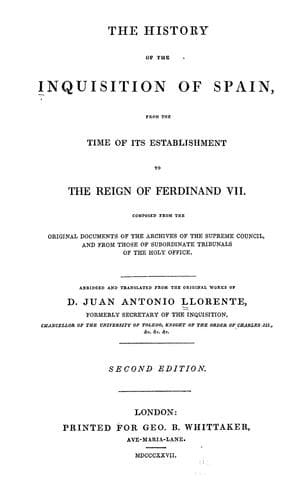
The History of the Inquisition of Spain from the Time of its Establishment to the Reign of Ferdinand VII.Llorente, Juan Antonio
History
The History of the Inquisition of Spain from the Time of its Establishment to the Reign of Ferdinand VII.
Llorente, Juan Antonio
Inquisition -- Spain
In 1634, another contest took place on the subject of competency,
concerning certain taxes which had been received from an inhabitant of
Vicalboro, near Madrid. The inquisitors of Toledo excommunicated a judge
of the royal court, and of the king's court, and committed the greatest
excesses against the authority of the Council of Castile, which,
impressed with a sense of its dignity, as the Supreme Senate of the
nation, commanded the Dean-inquisitor of Toledo to repair to Madrid, to
answer in person the charges brought against him, and threatened, in
case he refused, to deprive him of his property and temporal rights. It
also condemned a priest, the secretary of the holy office, to banishment
and confiscation, and ordered the Inquisitor of Madrid to give up the
prisoners and the writings of the trial to the chamber of judges of the
court. The council made an address to the king, requesting him to forbid
the inquisitors the use of censures, and to deliver his people from the
oppression under which they suffered. The king merely renewed the
prohibition of employing excommunication without an absolute necessity,
and decreed that it should never be employed against judges without a
particular permission. This ordinance shows the neglect or contempt into
which the Convention of Cardinal Zapata had fallen, only three years
after it had been established.
In 1640 the Inquisitors of Valladolid had another contest with the
bishop, who complained to the king, representing that the permission
granted by royal council to print or publish, without suppressing what
those authors who depend on the Inquisition write on the privileges of
that tribunal, would have the most fatal consequences. This assertion
was proved in 1641. Some disputes arose on the subject of competency,
between the Inquisition and the Chancery of Valladolid; the Council of
Castile was obliged to consult the king several times during the course
of the affair, and in one of its memorials stated, _that the
jurisdiction which the inquisitors exercise in the name of the king is
temporal, secular, and precarious, and cannot be defended by the use of
censures_. The members of the Council of the Inquisition in which Don
Antonio de Sotomayor the inquisitor-general presided, carried their
presumption so far as to convoke an assembly of ignorant scholastic
theologians, all chosen from the monks, to _qualify_ the proposition
advanced by the Council of Castile. These qualifiers, eager to display
their penetration, divided it into three parts.
"_First part._ The jurisdiction which the inquisitors exercise in the
name of the king is temporal and secular.--QUALIFICATION. _This
proposition is probable, if considered on the fairest side._"
"_Second part._ The said jurisdiction is precarious.--QUALIFICATION.
_This proposition is false, improbable, and contrary to the welfare of
his majesty._"
Public-domain text, read in full here on John Shaqi.
Reviews
Reviews
No reviews yet
Be the first to share your thoughts on this work.
Elsewhere in the archive
Join the Discussion
Join the discussion
Sign in to leave a comment or review.
Sign InorCreate an account