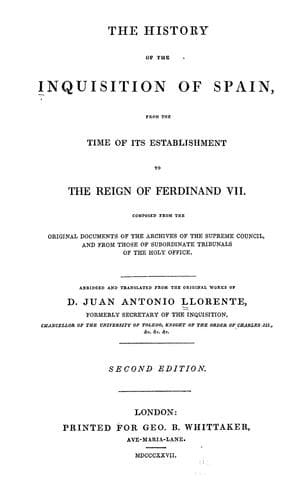
The History of the Inquisition of Spain from the Time of its Establishment to the Reign of Ferdinand VII.Llorente, Juan Antonio
History
The History of the Inquisition of Spain from the Time of its Establishment to the Reign of Ferdinand VII.
Llorente, Juan Antonio
Inquisition -- Spain
In 1507 the Inquisition, instigated by Ferdinand V., undertook to
prosecute and arrest Cæsar Borgia, Duke de Valentinois, and
brother-in-law to John d'Albret, King of Navarre. It is most probable
that this prince would have been taken, if he had not been killed in the
same year before Viana, not far from Logroño, by the governor of a
fortress, Juan Garces de los Fayos. Cæsar Borgia was the natural son of
Don Rodrigo de Borgia (afterwards raised to the papal see, by the name
of Alexander VI.), and the famous _Vanoci_. He had been a cardinal, but,
in 1499, his father, in compliance with the request of Louis XII. King
of France, who adopted him, granted him dispensations to marry the
sister of the King of Navarre; he then obtained the titles and estates
of the dukedom of Valentinois. A short time after the death of Cæsar
Borgia's father, in 1503, he was arrested at Naples, by the order of
Gonzalo de Cordova, viceroy of that monarchy, on the pretence that he
disturbed the tranquillity of the kingdom. He was taken to Spain, and
confined in the Castle of Medina del Campo, from whence he made his
escape, and fled to Navarre. Ferdinand, finding that his niece, the
Queen of Navarre, would not give up this prince to him, resolved to
secure him by means of the Inquisition.
It has been already stated that the inquisitors did not prosecute the
memory of Charles V.; but in 1565, they were concerned in the
proceedings against Jane d'Albret, the hereditary Queen of Navarre, and
against her son, Henry de Bourbon, afterwards Henry IV. of France, and
his sister, Margaret de Bourbon Albret, who married the sovereign Duke
of Bar. The holy office, however, did not take an active part in this
affair. After Ferdinand V. had taken possession of the five districts of
the kingdom of Navarre, called _Merindades_, he refused to recognise
either Jane or Henry de Bourbon as sovereigns of Navarre. These princes
were deprived of all their dominions, except the sixth _Merindade_ of
Navarre, by a papal bull in 1512; the Court of Rome also refused to
grant them the title of Kings of Navarre until the year 1561. The first
to whom it was given was Anthony de Bourbon.
Public-domain text, read in full here on John Shaqi.
Reviews
Reviews
No reviews yet
Be the first to share your thoughts on this work.
Elsewhere in the archive
Join the Discussion
Join the discussion
Sign in to leave a comment or review.
Sign InorCreate an account