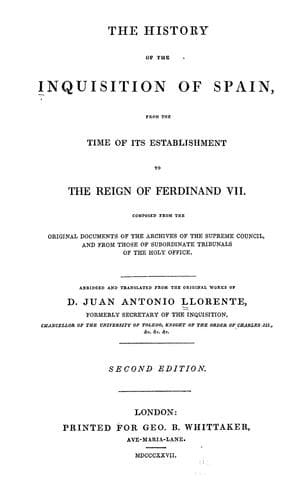
The History of the Inquisition of Spain from the Time of its Establishment to the Reign of Ferdinand VII.Llorente, Juan Antonio
History
The History of the Inquisition of Spain from the Time of its Establishment to the Reign of Ferdinand VII.
Llorente, Juan Antonio
Inquisition -- Spain
The Spanish monarch endeavoured to obtain, by means of the Inquisition
of Spain, what he had been refused by that of Rome. The
inquisitor-general Cardinal Espinosa, in concert with the Cardinal de
Lorraine, caused several witnesses to be examined, to prove that Jane
d'Albret and her children were Huguenots, and that, as they encouraged
this heresy in their states, it might spread into Spain. Espinosa (who
pretended that Philip was ignorant of his proceedings) informed the
council that it was necessary to impart this circumstance to his
majesty, and entreat him to do all in his power to prevent Jane from
persecuting the Catholics.
Philip secretly directed the affairs of the _League_ in France by means
of communications with the chiefs of the party; and according to his
orders the inquisitor-general formed a plot to carry off the Queen of
Navarre and her two children, and confine them in the dungeons of the
Inquisition of Saragossa. He hoped to succeed in this enterprise,
through the assistance afforded him by the Cardinal de Lorraine, and the
other chiefs of the _League_.
Those French historians who wrote after this period (such as the Abbé
St. Real, Mercier, and others) have endeavoured to throw all the odium
of this plot on Philip II. and the Duke of Alva; but as truth is the
first duty of historians, I am compelled to say, that the De Guises were
the authors of it. Nicolas de Neuville, Lord of Villeroy, minister and
first secretary of state during the reigns of Charles IX., Henry III.,
Henry IV., and Louis XIII., has left details of this affair, in a
_Memoir_ which was found after his death among his papers, and which has
been printed with many others, under the title of _Secret Memoirs of M.
de Villeroi_. This author, who was a contemporary, and acquainted with
the secrets of the government, seems to be more deserving of confidence
than any other.
Philip II. took advantage of the attempt, though it entirely failed; and
wrote to represent to the Pope, that his subjects in the neighbourhood
of France might imbibe the heresy, and demanded and obtained an order to
separate from the bishopric of Bayonne the villages of the valley of
Bastan, and those of the arch-priesthood of Fontarabia.
In 1563, the Inquisition of Murcia condemned another prince, called Don
Philip of Aragon. See Chapter 23.
In 1589, the Prince Alexander Farnese, governor-general of the Low
Countries and Flanders, and uncle to Philip II., was denounced to the
Inquisition of Spain, as suspected of Lutheranism, and a favourer of
heretics; it was also said, that he intended to become the sovereign of
Flanders, for which purpose he courted the Protestants. No proofs of
heresy were produced, and the inquisitor-general suspended the
proceedings. Although the enemies of Prince Farnese made every effort to
ruin him, Philip did not deprive him of his office, and he remained
Governor of the Low Countries till his death in 1592. It has been said
that he was poisoned by Philip II.
Public-domain text, read in full here on John Shaqi.
Reviews
Reviews
No reviews yet
Be the first to share your thoughts on this work.
Elsewhere in the archive
Join the Discussion
Join the discussion
Sign in to leave a comment or review.
Sign InorCreate an account