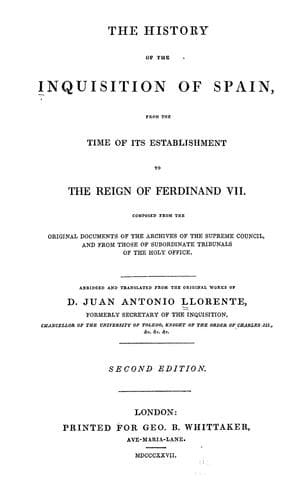
The History of the Inquisition of Spain from the Time of its Establishment to the Reign of Ferdinand VII.Llorente, Juan Antonio
History
The History of the Inquisition of Spain from the Time of its Establishment to the Reign of Ferdinand VII.
Llorente, Juan Antonio
Inquisition -- Spain
The venerable Fray Louis de Grenada, born in 1504, was the disciple of
Juan d'Avila; he was of the order of St. Dominic, and left several works
on religion. He was implicated in the trial of the Lutherans at
Valladolid; Fray Dominic de Roxas defended his opinions, by saying that
they were the same as those of Fray Louis de Grenada, Carranza, and
other good Catholics. The procurator-fiscal made Fray Dominic renew his
declaration, with the intention of producing him as a witness in the
trial of Fray Louis: Fray Dominic was burnt five days after. A sentence
condemning some of his works was also brought against Fray Louis.
He was denounced a third time as one of the _Illuminati_, but was
acquitted. Fray Louis died in 1588. His works are well known: it is
singular that the Index in which his condemnation was published, was
afterwards prohibited by the inquisitor-general Quiroga.
The venerable Don Juan de Palafox y Mendoza, the natural son of Don
James Palafox, afterwards Marquis de Hariza and of Donna Maria de
Mendoza (who soon after became a Carmelite); he was born in 1600. He was
made Bishop de la Puebla de los Angelos, in America, in 1639; afterwards
Archbishop and Viceroy of Mexico; and lastly, Bishop of Osma, in Spain,
in 1653. He died in 1659, leaving several works on history, devotion,
and mysticity, and with so great a reputation of sanctity, that his
canonization is pending at Rome.
Don Juan had great disputes with the Jesuits in America, on account of
the privileges of his rank, of which the Fathers wished to deprive him.
The most important of his writings, is his letter to Pope Innocent X.,
who terminated their disputes, to a certain degree, by a brief, in 1648.
The Jesuits did not consider themselves vanquished; they denounced the
archbishop as one of the _Illuminati_ and a false devotee, at Rome, at
Madrid, and at Mexico. The provincial inquisitors of the last city
applied to the Supreme Council, and the venerable Palafox suffered
everything from them which they could inflict, except imprisonment.
They condemned and prohibited the writings which the archbishop had
published in his defence, and circulated those of his adversaries, and
some libels which they had framed to ruin Don Antonio Gabiola,
procurator-fiscal to the Inquisition, who openly disapproved of the
conduct of the Jesuits.
This officer wrote to Palafox in 1647, exhorting him to make every
effort, that the trials before the Inquisition of Mexico should proceed
in a regular manner, according to the spirit of the institution, and
encouraging him to oppose his formidable enemies.
The Jesuits, by their intrigues, succeeded in causing some of the works
of Palafox to be placed in the Index, but the congregation of cardinals
having afterwards declared that they contained nothing reprehensible, or
which could impede his beatification, the inquisitors were obliged to
efface them from the catalogue.
CHAPTER XXXI.
Public-domain text, read in full here on John Shaqi.
Reviews
Reviews
No reviews yet
Be the first to share your thoughts on this work.
Elsewhere in the archive
Join the Discussion
Join the discussion
Sign in to leave a comment or review.
Sign InorCreate an account