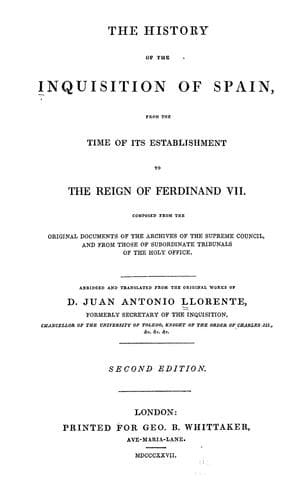
The History of the Inquisition of Spain from the Time of its Establishment to the Reign of Ferdinand VII.Llorente, Juan Antonio
History
The History of the Inquisition of Spain from the Time of its Establishment to the Reign of Ferdinand VII.
Llorente, Juan Antonio
Inquisition -- Spain
I have not found in the MSS. I have examined, anything which might lead
to the supposition that Don Carlos was in love with the queen; the
opinion must have been founded on the article in the secret
preliminaries, which, there is reason to suppose, the prince was never
acquainted with. He had scarcely recovered, and the queen was still in a
state of convalescence, when the king sent him to Alcala de Henares. He
was accompanied by Don John of Austria, his uncle, and by Alexander
Farnese, the hereditary Prince of Parma, his cousin; his governor,
master, and almoner, also attended him, with other domestics. The king
expected that this journey would restore the health of his son, and also
wished that he should apply himself to his studies, for he did not yet
understand Latin. Don Honorato Juanez perceived his dislike to learning
foreign languages, and therefore gave him his lessons in Spanish.
On the 9th of May, 1552, Don Carlos, who was then seventeen years of
age, fell down the staircase of his palace, and received several wounds,
principally in the spine and head, some of which appeared to be mortal.
As soon as the king was informed of the accident, he set off for the
palace, that he might give him every assistance, and ordered all the
archbishops, and other superior ecclesiastics of the kingdom, to offer
up prayers for the recovery of his son. The king, supposing him to be
already at the point of death, sent for the body of the blessed Diego, a
lay Franciscan, by which it was said that many miracles had been
performed. This body was laid upon that of Don Carlos, and as he began
to recover from that time, it was attributed to the protection of St.
Diego, who was canonized a short time after, at the request of Philip
II. It must be observed, that the prince was attended by the celebrated
Don Andrea Basilio, the king's physician, who opened his skull, freed it
from a considerable quantity of water which had accumulated, and thus
saved his life; but he never entirely recovered, and was subject to
pains and weakness in the head, which prevented him from studying, and
by producing a disorder in his ideas, rendered his character still more
insupportable.
Don Carlos returned to court in 1564, emancipated from his masters:
Philip recompensed Don Honorato Juanez, by making him bishop of Osma.
The solid piety and amiableness of this prelate had inspired Don Carlos
with an affection which their separation did not interrupt: this is
proved by his letters, which do not give a very advantageous idea of his
capacity or information. He often left sentences imperfect, and a
different meaning might be inferred from them from what he wished to
express. The following is a letter addressed to the prelate:--
Public-domain text, read in full here on John Shaqi.
Reviews
Reviews
No reviews yet
Be the first to share your thoughts on this work.
Elsewhere in the archive
Join the Discussion
Join the discussion
Sign in to leave a comment or review.
Sign InorCreate an account