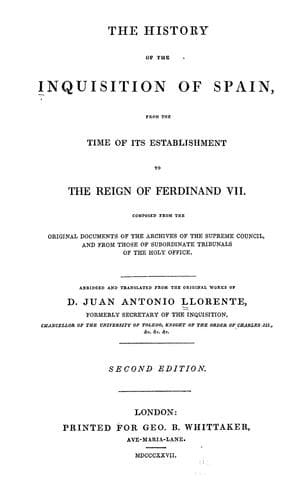
The History of the Inquisition of Spain from the Time of its Establishment to the Reign of Ferdinand VII.Llorente, Juan Antonio
History
The History of the Inquisition of Spain from the Time of its Establishment to the Reign of Ferdinand VII.
Llorente, Juan Antonio
Inquisition -- Spain
The Bishop of Osma being informed of the irregular conduct of Don
Carlos, and having also received private orders from the king, wrote a
long letter to him[41], directing him how to behave to the king's
ministers, and demonstrating the incalculable evils that would arise
from a different line of conduct. He took particular pains to avoid an
insinuation that the prince stood in need of these admonitions. Don
Carlos received the letter with the respect he always showed for the
worthy prelate, but he did not follow his advice, and had given himself
up to the greatest excesses, when he learnt that his father had bestowed
the government of Flanders on the Duke of Alva. The duke went to take
leave of the prince, who told him that the government was more suitable
to the heir of the crown. The duke replied, that doubtless the king did
not wish to expose him to the dangers which he would incur in the Low
Countries from the quarrels which had arisen between the principal
noblemen. This reply, instead of appeasing Don Carlos, irritated him
still more; he drew his dagger, and endeavoured to stab the duke,
crying, _I will soon prevent you from going to Flanders, for I will stab
you to the heart before you shall go_. The duke avoided the blow by
stepping back; the prince continued the attack, and the duke had no
means of escaping but by seizing Don Carlos in his arms, and although
their strength was very unequal, he succeeded in arresting the blows of
this madman. As Don Carlos still struggled, the duke made a noise in the
apartment, and the chamberlains entered; the prince then made his
escape, and retired to his cabinet to await the result of this scene,
which could not but be disagreeable if the king was informed of it[42].
The vices of Don Carlos could not destroy the affection of the Emperor
of Germany, his uncle, or that of the Empress Maria, his aunt. These
sovereigns wished to marry him to Anne of Austria, their daughter: this
princess had been known to Don Carlos from her earliest years, as she
was born at Cigales in Spain in 1549. Philip consented to this marriage;
but fearing, perhaps, to make his niece miserable if the character and
morals of Don Carlos did not change, he proceeded in the affair with his
usual tardiness. On the contrary, as soon as the prince was informed of
what was in contemplation, he wished to marry his cousin immediately;
and for that purpose resolved to go to Germany without the consent of
his father, hoping that his presence at Vienna would induce the emperor
to overcome all difficulties. Full of this idea, he employed himself in
the execution of his design, and was assisted by the Prince of Orange,
the Marquis de Berg, the Counts Horn and Egmont, and by the Baron de
Montigny, the chiefs of the conspiracy in Flanders. Don Carlos must be
also included among the victims of this conspiracy[43].
Public-domain text, read in full here on John Shaqi.
Reviews
Reviews
No reviews yet
Be the first to share your thoughts on this work.
Elsewhere in the archive
Join the Discussion
Join the discussion
Sign in to leave a comment or review.
Sign InorCreate an account