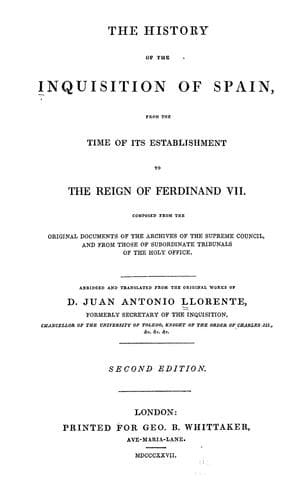
The History of the Inquisition of Spain from the Time of its Establishment to the Reign of Ferdinand VII.Llorente, Juan Antonio
History
The History of the Inquisition of Spain from the Time of its Establishment to the Reign of Ferdinand VII.
Llorente, Juan Antonio
Inquisition -- Spain
lieutenant-captains of the Spanish and German guards, to place eight or
ten halberdiers outside the porch. These men shall also mount guard at
the doors of the infantas; two shall be placed in the apartment of Rui
Gomez, from the time when the great gate of the palace is opened, until
midnight, when the prince's chamber shall be closed, and the _monteros_
commence their service. Each nobleman is permitted to have a servant for
his own use; he shall select from his people the one he has most
confidence in. All these persons shall make oath, before the Prince
d'Evoli, to execute faithfully the regulations contained in this
ordinance. Rui Gomez, and the noblemen under his orders, shall inform
the king of any negligence in this respect. The said Rui Gomez is
commanded to supply all that shall be considered necessary in the
service, and which has not been stated in this ordinance. As all the
responsibility rests upon him, his orders must be executed by the people
under him."
The secretary Hoyo read this ordinance to all the persons employed, and
to each in particular; they all took the oath required.
It has been shown by the recital of the usher, that Philip gave orders
for the trial of his son. The king having proceeded to the interrogation
of the witnesses, by means of the secretary Hoyo, created a special
commission to examine into the affair. It was composed of Cardinal
Espinosa, the inquisitor-general, the Prince of Evoli, and Don Diego
Bribiesca de Muñatones, a counsellor of Castile: the king presided.
Muñatones was charged with the instruction of the process. Philip, who
wished to give this affair the air of a proceeding for a crime of
_lese-majesté_, caused to be brought from the royal archives of
Barcelona, the writings of a trial instituted by his great-great
grandfather, John II., King of Aragon and Navarre, against Charles, his
eldest son, Prince of Biana and Girone, who had already been
acknowledged as the successor to the throne.
The ordinance concerning the imprisonment of Don Carlos was so strictly
observed, that the queen and the princess Jane, who wished to see and
console him, were refused permission to do so by the king. Philip was so
suspicious of every one, that he lived in a kind of captivity, and did
not make his accustomed excursions to Aranjuez, the Pardo, and the
Escurial. He kept himself shut up in his apartment; the least noise in
the street drew him to the window, such was his dread of some tumult. He
had always suspected the Flemings, or other persons, of being the
prince's partisans, or at least to affect it.
Public-domain text, read in full here on John Shaqi.
Reviews
Reviews
No reviews yet
Be the first to share your thoughts on this work.
Elsewhere in the archive
Join the Discussion
Join the discussion
Sign in to leave a comment or review.
Sign InorCreate an account