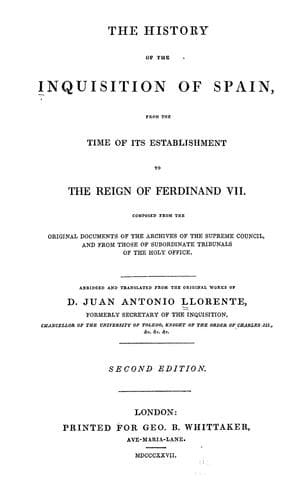
The History of the Inquisition of Spain from the Time of its Establishment to the Reign of Ferdinand VII.Llorente, Juan Antonio
History
The History of the Inquisition of Spain from the Time of its Establishment to the Reign of Ferdinand VII.
Llorente, Juan Antonio
Inquisition -- Spain
In the same year, 1540, Carranza was appointed Bishop of Cuzco, but he
refused to go to South America, except as a preacher of the gospel. In
1544, Carranza was sent to the Council of Trent, as theologian to
Charles V. He remained there three years, and it was there that Cardinal
Pacheco (dean of the Spanish prelates who attended at the council)
engaged him to preach on _justification_ before the Fathers. In 1546, he
published at Rome one of his works, called _The Summary of Councils_;
and another at Venice, of _Theological Controversies_. In 1547 he
published a treatise _On the Residence of Bishops_, which created him
many enemies, and which was attacked by Fray Ambrose Caterino, and
defended by Fray Dominic de Soto, both Dominicans.
On his return to Spain, in 1548, he refused the appointment of
confessor to Philip II., then prince of the Asturias, and in 1549
declined accepting the bishopric of the Canaries. He was elected in the
same year prior of the Dominicans of Palencia, which he accepted. In
1550 he was made provincial of the Convents of Castile, and visited his
province.
The Council of Trent being again convoked in 1651, Carranza was
commanded by the emperor to attend it, and furnished with full powers by
the Cardinal Archbishop of Toledo; he assisted at the different
assemblies until 1552, when he was suspended the second time. Among the
different commissions confided to him, was that of preparing an _Index_.
On his return to Spain, the period of his provincialship had expired,
and he re-entered his College of St. Gregory of Valladolid.
The alliance between Philip II. and Mary, Queen of England, being fixed,
Fray Bartholomew, in 1554, went to England in order to assist Cardinal
Pole in preparing the kingdom to return to the Catholic faith. Carranza
passed the greatest part of his time in preaching, and succeeded in
converting a great number of heretics. When the king left England to go
to Brussels, Carranza remained with the queen, to whom he was useful in
supporting the Catholic doctrine in the universities, and arranging
other affairs of the greatest importance. He revised, by the order of
Cardinal Pole, the canons which had been decreed by a national council,
and caused several obstinate heretics to be punished, particularly
Thomas Cranmer, Archbishop of Canterbury, and Martin Bucer; his zeal
often exposed him to great danger.
In 1557 he went to Flanders, where he caused all books infected with the
heresy of Luther to be burnt. He did the same at Frankfort, and also
informed the king that many of these books were introduced into Spain by
way of Aragon. Philip, in consequence, gave the necessary orders to the
inquisitor-general to intercept these works. In order to render this
measure more effectual, Carranza drew up a list of suspected Spaniards
who had fled to Germany and Flanders. The original copy of this list was
found among his papers when he was arrested.
Public-domain text, read in full here on John Shaqi.
Reviews
Reviews
No reviews yet
Be the first to share your thoughts on this work.
Elsewhere in the archive
Join the Discussion
Join the discussion
Sign in to leave a comment or review.
Sign InorCreate an account