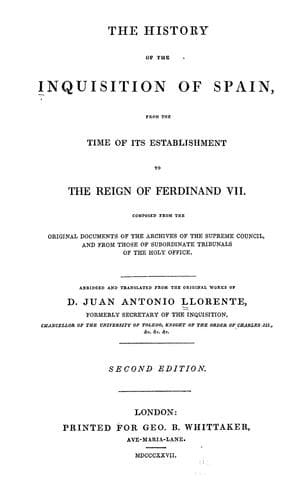
The History of the Inquisition of Spain from the Time of its Establishment to the Reign of Ferdinand VII. — John Shaqi
The History of the Inquisition of Spain from the Time of its Establishment to the Reign of Ferdinand VII.Llorente, Juan Antonio
History
The History of the Inquisition of Spain from the Time of its Establishment to the Reign of Ferdinand VII.
Llorente, Juan Antonio
Inquisition -- Spain
It appears, from the examination of some of the murderers, that the
inquisitor wore a coat of mail under his vest, and a kind of helmet
covered with a cap. He was at last assassinated in the metropolitan
church, during the performance of the matins, on the 15th of November,
1485. Vidal d'Uranso wounded him so severely in the back of the neck,
that he died two days after. The next day the murder was known in the
town, but its effects were different from what had been expected, for
all the _Old Christians_, or those who were not of Jewish origin,
persuaded that the _New Christians_ had committed the crime, assembled
to pursue them and revenge the death of the inquisitor. The disturbance
was violent, and its consequences would have been terrible, if the young
archbishop, Don Alphonso of Aragon, had not shewn himself, and assured
the multitude that the criminal should be punished. Policy inspired
Ferdinand and Isabella with the idea of honouring the memory of Arbuès
with a solemnity which contributed to make him pass for a saint, and
caused a particular worship to be addressed to him. This took place long
after, when Pope Alexander VII. had beatified him as a martyr, in 1664.
A magnificent monument was erected to his memory, by Ferdinand and
Isabella. While the sovereigns were occupied in honouring the remains of
Peter Arbuès, the inquisitors of Saragossa were labouring without
ceasing to discover the authors and accomplices of his murder, and to
punish them as Judaic heretics and enemies to the holy office. It would
be difficult to enumerate the number of families plunged into misery
through their vengeance; two hundred victims were soon sacrificed.
Vidal d'Uranso, one of the assassins, revealed all he knew of the
conspiracy, which was the cause of the discovery of its authors. There
was scarcely a single family in the three first orders of nobility,
which was not disgraced by having at least one of its members in the
_auto-da-fé_, wearing the habit of a penitent.
Don James Diaz d'Aux Armendarix, lord of the town of Cadreita, a knight
of Navarre, and ancestor of the Dukes of Albuquerque, was condemned to a
public penance, for having concealed in his house, for one night,
several persons who fled from Saragossa. The same punishment was
inflicted on several other illustrious knights of the town of Tudela in
Navarre, for having received and concealed other fugitives. Don James de
Navarre (the son of Eleanor, Queen of Navarre, and Gaston de Foix) was
imprisoned in the dungeons of the Inquisition, and was subjected to a
public penance for having assisted several of the conspirators in their
flight. The inquisitors knew, when they had the audacity to imprison
him, that he was not beloved by Ferdinand, who always feared him,
although he was not legitimate.
Public-domain text, read in full here on John Shaqi.
Reviews
Reviews
No reviews yet
Be the first to share your thoughts on this work.
Join the Discussion
Join the discussion
Sign in to leave a comment or review.
Sign InorCreate an account