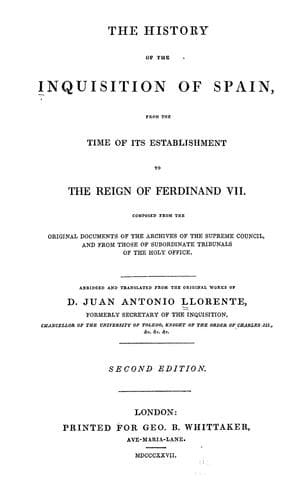
The History of the Inquisition of Spain from the Time of its Establishment to the Reign of Ferdinand VII.Llorente, Juan Antonio
History
The History of the Inquisition of Spain from the Time of its Establishment to the Reign of Ferdinand VII.
Llorente, Juan Antonio
Inquisition -- Spain
Don Lope Ximenez de Urrea, first count of Aranda; Don Louis Gonzalez,
secretary to the king; Don Alphonso de la Caballeria, vice-chancellor of
the kingdom; and many other persons of equal rank, were condemned to the
same punishment. John de Esperaindeo and the other assassins of Arbuès
were hung, after having their hands cut off. Their bodies were
quartered, and their limbs exposed in the highways. John de l'Abadia
killed himself in prison the day before the execution, but his corpse
was treated in the same manner as the others. The hands of Vidal
d'Uranso were not cut off until he had expired, because he had been
promised his pardon if he discovered the conspirators.
All the other provinces of Aragon made an equal resistance to the
introduction of the new Inquisition. The seditions at Teruel were only
quelled in 1485, by extreme severity. The town and bishopric of Lerida,
and other towns in Catalonia, obstinately resisted the establishment of
the reform, and were not reduced to obedience until 1487. Barcelona
refused to acknowledge Torquemada or any of his delegates, on account of
a privilege which it possessed of having an inquisitor with a special
title. The king applied to the Pope, who instituted Torquemada special
inquisitor of the town and bishopric of Barcelona, with the power of
appointing others to the office. The king was obliged to employ the same
method with the inhabitants of Majorca and those of Sardinia, who did
not receive the Inquisition until 1490 and 1492. It is an incontestable
fact in the history of the Spanish Inquisition, that it was introduced
entirely against the consent of the provinces, and only by the influence
of the Dominican monks.
CHAPTER VII.
ADDITIONAL ACTS TO THE FIRST CONSTITUTION OF THE HOLY OFFICE;
CONSEQUENCES OF THEM, AND APPEALS TO ROME AGAINST THEM.
The inquisitor-general judged it necessary to augment the laws of the
holy office; and added eleven new articles to them; the substance of
them is as follows:--
1st. That each inferior tribunal should consist of two inquisitors as
civilians, an attorney, an alguazil, a recorder and other persons, if
necessary, who were to receive a fixed salary. The same article
prohibits the admission of the servants or creatures of the inquisitors
into the tribunal.
2nd. That if any of the persons employed should receive presents from
the accused or his family, he should be immediately deprived of his
office.
3rd. That the holy office should employ an able civilian at Rome, under
the title of agent, and that this expense, should be supported by the
money arising from the confiscations.
4th. That the contracts signed before the year 1479, by persons whose
property had since been seized, should be regarded as valid; but if it
was proved that any deception had been used in the transactions, that
the culprits should be punished by a hundred strokes of a whip, and
branded on the face with a red-hot iron.
Public-domain text, read in full here on John Shaqi.
Reviews
Reviews
No reviews yet
Be the first to share your thoughts on this work.
Join the Discussion
Join the discussion
Sign in to leave a comment or review.
Sign InorCreate an account