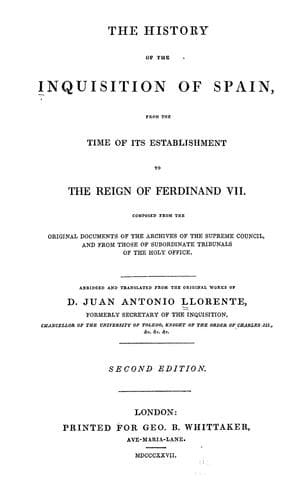
The History of the Inquisition of Spain from the Time of its Establishment to the Reign of Ferdinand VII.Llorente, Juan Antonio
History
The History of the Inquisition of Spain from the Time of its Establishment to the Reign of Ferdinand VII.
Llorente, Juan Antonio
Inquisition -- Spain
These sums, and the care which people took to conceal their effects,
diminished the funds of the Inquisition; besides which, most of the _New
Christians_ were merchants or artisans, and it often happened that the
receivers who paid the royal gifts were unable to pay the salaries of
the inquisitors. Torquemada, in 1488, decreed that the royal gifts
should not be paid, until the salaries and other expenses of the
Inquisition had been defrayed, and wrote to request the approbation of
Ferdinand, who refused it. The inquisitor-general was then obliged to
permit the inquisitors to impose pecuniary penalties on reconciled
persons (which permission was afterwards revoked). As experience showed
that the revenue of the Inquisition was never sufficient, on account of
the great number of prisoners which it was obliged to maintain, and the
expenses incurred by the agent at Rome, Ferdinand and Isabella requested
the Pope to place at the disposal of the holy office, a prebendary in
each cathedral in their dominions; to which he consented in 1501. The
receivers finding themselves unable to defray the expenses of the
administration, demanded restitution of many persons whom they accused
of retaining estates belonging to the Inquisition. This conduct caused
so many complaints, that the council of the Inquisition was obliged to
prohibit the receivers from molesting the proprietors of estates which
had been sold before the year 1479. It is not surprising that the
receivers should employ such measures to augment the revenue, when the
inquisitors contributed to impoverish it themselves, by disposing of it
according to their caprices, and without the permission of the
sovereigns. This abuse rose to such a height, that Ferdinand and
Isabella complained to the Pope, who prohibited the inquisitors from
disposing of their revenues without an order from the king, on pain of
excommunication. The inquisitors were afterwards obliged to refund the
sums which they had seized.
In 1488 the inquisitor-general formed, with the assistance of the
supreme council, a new ordinance, which consisted of fifteen articles.
The first decreed that the regulations of 1484 should be followed in all
things, except in regard to the confiscations, which were to be
regulated by the rules of equity.
The 2nd enjoins the inquisitors to proceed in a uniform manner, on
account of the abuses produced by a contrary system.
The 3rd prohibits inquisitors from delaying to pass sentence, on the
pretence of waiting for the full proof of the crime.
The 4th imports, that as there are not in all the tribunals civilians of
sufficient ability to be consulted in the preparation of the definitive
sentences, the inquisitors shall send the writings of the trials to the
inquisitor-general, in order to be examined by the civilians of the
supreme council.
Public-domain text, read in full here on John Shaqi.
Reviews
Reviews
No reviews yet
Be the first to share your thoughts on this work.
Join the Discussion
Join the discussion
Sign in to leave a comment or review.
Sign InorCreate an account