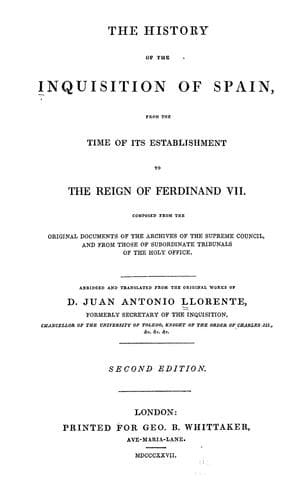
The History of the Inquisition of Spain from the Time of its Establishment to the Reign of Ferdinand VII.Llorente, Juan Antonio
History
The History of the Inquisition of Spain from the Time of its Establishment to the Reign of Ferdinand VII.
Llorente, Juan Antonio
Inquisition -- Spain
5th. That the nobles who should receive fugitives in their estates,
should be compelled to deliver up to government the property committed
to their care; and if they claimed the fulfilments of contracts signed
by the accused for their profit, that the attorney should commence an
action to reclaim the property at belonging to the revenue.
6th. That the notaries of the Inquisition should keep an account of the
property of the condemned persons.
7th. That the stewards of the holy office could sell the confiscated
property, and receive the rents of the estates which might be let.
8th. That each steward should inspect the property belonging to his
tribunal.
9th. That a steward could not sequestrate the property of a condemned
person, without an order from the Inquisition; and even in that case,
that he should be accompanied by an alguazil, and place the effects and
an inventory of them in the hands of a third person.
10th. That the steward should pay the salaries of the inquisitors
quarterly, that they might not be obliged to receive presents.
11th. That in all circumstances not foreseen in the new regulations, the
inquisitors should conduct themselves with prudence, and apply to the
government in all difficult cases.
The nature of these articles proves that the number of confiscations
had been considerable. Ferdinand and Isabella often gave the property of
the condemned persons to their wives and children, granted them pensions
on the property, or a certain sum to be paid by the receiver-general.
Public-domain text, read in full here on John Shaqi.
Reviews
Reviews
No reviews yet
Be the first to share your thoughts on this work.
Join the Discussion
Join the discussion
Sign in to leave a comment or review.
Sign InorCreate an account