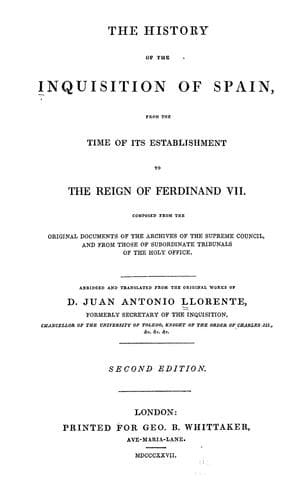
The History of the Inquisition of Spain from the Time of its Establishment to the Reign of Ferdinand VII.Llorente, Juan Antonio
History
The History of the Inquisition of Spain from the Time of its Establishment to the Reign of Ferdinand VII.
Llorente, Juan Antonio
Inquisition -- Spain
The other European courts were not thus influenced by fanaticism, and
paid no attention to a bull of Innocent VIII., which commanded all
governments to arrest, at the desire of Torquemada, the fugitives whom
he should designate, on pain of excommunication; the monarch was the
only person exempted from the penalty.
The insolent fanatic, Torquemada, while he affected to refuse the honour
of episcopacy through modesty, was the first who gave the fatal example
of subjecting bishops to trial. Not satisfied with having obtained from
Sixtus IV. the briefs which prohibited bishops of Jewish origin from
interfering in the affairs of the Inquisition, he even wished to put
two on their trial, namely, Don Juan Arias Davila, Bishop of Segovia;
and Don Pedro de Aranda, Bishop of Calahorra. He made his resolution
known to the Pope, who informed him that his predecessor, Boniface
VIII., had prohibited the Inquisition from proceeding against bishops,
archbishops, or cardinals, without an apostolical commission; but if any
prelate was accused of heresy, he charged Torquemada to send him a copy
of the informations, that he might decide on the method to be pursued.
Torquemada immediately began to take secret informations of the conduct
of the bishops, and the Pope sent Antonio Palavicini, Bishop of Tournai,
to Spain, with the title of apostolical nuncio, when he received the
informations of Torquemada, and returned to Rome, where the two bishops
were cited to appear and defend themselves. Don Juan Arias Davila was
the son of Diego Arias Davila, who was of Jewish origin, and was
baptized after the preaching of St. Vincent Ferrier; he afterwards
became chief financier to the kings John II. and Henry IV. Henry IV.
ennobled him, and gave him the lordship of the Castle of Puñonrostro,
and several other places which form the countship of Puñonrostro, and
the title of Grandee of Spain, which has been possessed by his
descendants from the time of Pedro Arias Davila, the first count, and
brother to the bishop, and who was also chief financier to Henry IV. and
Ferdinand V. The rank of the bishop did not intimidate Torquemada;
informations were taken by his order, and the result was, that Diego
Arias Davila died a Judaic heretic: the object which the
inquisitor-general had in view, was to condemn his memory, confiscate
his property, and to disinter his body, in order to burn it with his
effigy. As, in all affairs of this nature, the children are cited to
appear, Don Juan Arias Davila was obliged to repair to Rome in 1490, to
defend his father and himself, although he had arrived at a great age,
and had been Bishop of Segovia thirty years. He was well received by
Alexander VI., who appointed him to accompany his nephew, the Cardinal
Montreal, to Naples, when he went to crown Ferdinand II. Davila returned
to Rome, and died there in 1497, after having cleared the memory of his
father.
Public-domain text, read in full here on John Shaqi.
Reviews
Reviews
No reviews yet
Be the first to share your thoughts on this work.
Elsewhere in the archive
Join the Discussion
Join the discussion
Sign in to leave a comment or review.
Sign InorCreate an account