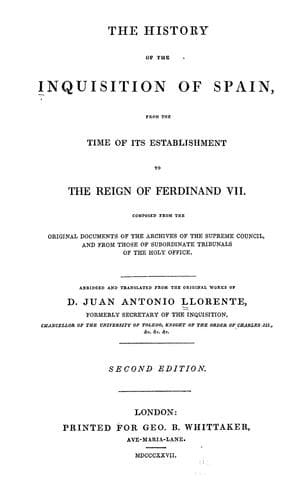
The History of the Inquisition of Spain from the Time of its Establishment to the Reign of Ferdinand VII.Llorente, Juan Antonio
History
The History of the Inquisition of Spain from the Time of its Establishment to the Reign of Ferdinand VII.
Llorente, Juan Antonio
Inquisition -- Spain
Don Pedro Aranda, Bishop of Calahorra, was not so fortunate. He was the
son of Gonzales Alonzo, a Jew, who was also baptized in the time of St.
Vincent Ferrier, and who was afterwards master of a chapel. Gonzales had
the pleasure of seeing both his sons attain the dignity of bishops: the
eldest was Archbishop of Montreal in Sicily, the second was made Bishop
of Calahorra, in 1478, and president of the Council of Castile in 1482;
yet in 1488 he was the object of a secret instruction, directed by
Torquemada, which however did not prevent him from convoking a synod in
the town of Logrogna, in 1492. At that period Torquemada, and the other
inquisitors of Valladolid, undertook the trial of Gonzales Alonzo, to
prove that he had died a Judaic heretic. The inquisitors of Valladolid
and the bishop of the diocese could not agree on the sentence to be
pronounced on the accused; and his son, Don Pedro Aranda, obtained a
brief from Alexander VI., by which this affair was referred to Don Inigo
Manrique, Bishop of Cordova, and John de St. John, prior of the
Benedictines at Valladolid. They were commissioned to pronounce judgment
and execute the sentence, without any interference on the part of the
Inquisition. Their decision was favourable to Gonzales.
The bishop, his son, gained the esteem of the Pope, who made him chief
major-domo of the pontifical palace, and sent him as ambassador to
Venice, in 1494. These marks of favour did not cause the inquisitors to
relax in their zeal: they proceeded in their trial against Don Pedro,
for heresy: his judges were the archbishop, the Governor of Rome, and
two bishops, auditors of the apostolical palace. Don Pedro called one
hundred and one witnesses for his defence; but unfortunately every one
of them had something to advance against him, on different points. The
judges made their report to the Pope, in a secret consistory, in 1498,
who, with the cardinals, condemned the bishop to be deprived of his
offices and benefices, to be degraded from his episcopal dignity, and
reduced to the rank of a simple layman. He was confined in the Castle of
Santangelo, where he died some time after.
Public-domain text, read in full here on John Shaqi.
Reviews
Reviews
No reviews yet
Be the first to share your thoughts on this work.
Elsewhere in the archive
Join the Discussion
Join the discussion
Sign in to leave a comment or review.
Sign InorCreate an account