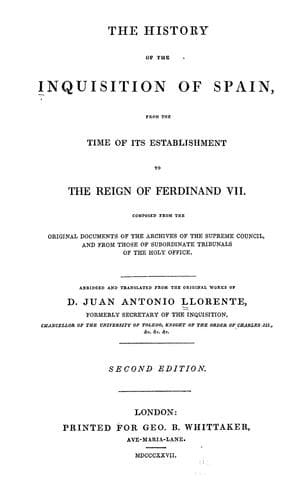
The History of the Inquisition of Spain from the Time of its Establishment to the Reign of Ferdinand VII.Llorente, Juan Antonio
History
The History of the Inquisition of Spain from the Time of its Establishment to the Reign of Ferdinand VII.
Llorente, Juan Antonio
Inquisition -- Spain
When the Regent of Spain arrived in that kingdom, he named Don Francisco
Ximenez de Cisneros inquisitor-general for the crown of Castile, and Don
Juan Enguera, Bishop of Vic, for that of Aragon. The Pope expedited
their bulls in 1507, and made Cisneros a cardinal.
Ximenez de Cisneros began to exercise his new employment on the 1st
October, when the conspiracy against the holy office had become almost
general, on account of the events at Cordova, of which the Council of
Castile took cognizance. All its members who had been of the party of
Philip I. signalized themselves by their hatred against the Inquisition.
This aversion made Ximenez de Cisneros feel the necessity of conducting
himself with extreme caution, that he might not give occasion for a
general convocation of the Cortes, which would have deprived him of the
high office of governor of the kingdom, which he then possessed.
The events at Cordova forced a great number of persons to appeal to
Rome. The Pope appointed two prelates to examine the trials, and made
Cardinal Cisneros judge of appeals, with the power of bringing all the
trials begun by the apostolical commissioners before him.
The cardinal immediately suspended the inquisitor Lucero, and sent him
prisoner to Burgos; he also imprisoned all those witnesses who were
suspected of having made false depositions, because some of the charges
were so absurd that no one could believe them. The examination of the
trials made the cardinal perceive, that an affair which implicated some
of the most illustrious families of Spain could not be treated with too
much delicacy:--he therefore obtained the king's permission to form a
junta, which he named the _Catholic Congregation_: it was composed of
twenty-two respectable persons, namely, the inquisitor-general (who was
the president); the inquisitor-general of Aragon; the Bishop of Ciudad
Rodrigo; those of Calahorra and Barcelona; the mitred abbot of the
Benedictines at Valladolid; the president of the Council of Castile, and
eight of its members; the vice-chancellor and the president of the
Chancery of Aragon; two counsellors of the _Supreme_; two provincial
inquisitors, and an auditor of the Chancery of Valladolid.
Their first assembly was held at Burgos, on Ascension-day, in 1508, and
on the 9th of July they decreed that the characters of the witnesses
were vile, contemptible, and unworthy of confidence; that their
declarations were full of contradictions; that they contained things
unworthy of belief, and contrary to common sense; that the prisoners
were consequently at liberty; that their honour, and that of the
prisoners who had died, was re-established; that the houses which had
been destroyed, as having been used for synagogues, should be rebuilt;
and that the judgment and the notes in the register should be erased.
Public-domain text, read in full here on John Shaqi.
Reviews
Reviews
No reviews yet
Be the first to share your thoughts on this work.
Elsewhere in the archive
Join the Discussion
Join the discussion
Sign in to leave a comment or review.
Sign InorCreate an account