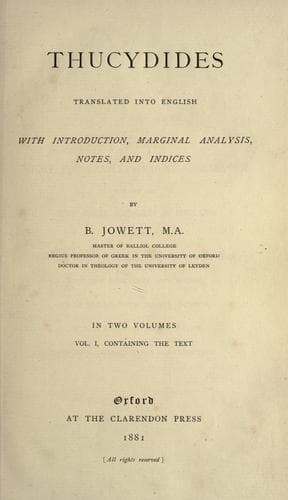
Greece -- History -- Peloponnesian War, 431-404 B.C.
The empire of the Odrysians extended along the seaboard from Abdera to
the mouth of the Danube in the Euxine. The navigation of this coast by
the shortest route takes a merchantman four days and four nights with a
wind astern the whole way: by land an active man, travelling by the
shortest road, can get from Abdera to the Danube in eleven days. Such
was the length of its coast line. Inland from Byzantium to the Laeaeans
and the Strymon, the farthest limit of its extension into the interior,
it is a journey of thirteen days for an active man. The tribute from
all the barbarian districts and the Hellenic cities, taking what they
brought in under Seuthes, the successor of Sitalces, who raised it to
its greatest height, amounted to about four hundred talents in gold and
silver. There were also presents in gold and silver to a no less
amount, besides stuff, plain and embroidered, and other articles, made
not only for the king, but also for the Odrysian lords and nobles. For
there was here established a custom opposite to that prevailing in the
Persian kingdom, namely, of taking rather than giving; more disgrace
being attached to not giving when asked than to asking and being
refused; and although this prevailed elsewhere in Thrace, it was
practised most extensively among the powerful Odrysians, it being
impossible to get anything done without a present. It was thus a very
powerful kingdom; in revenue and general prosperity surpassing all in
Europe between the Ionian Gulf and the Euxine, and in numbers and
military resources coming decidedly next to the Scythians, with whom
indeed no people in Europe can bear comparison, there not being even in
Asia any nation singly a match for them if unanimous, though of course
they are not on a level with other races in general intelligence and
the arts of civilized life.
It was the master of this empire that now prepared to take the field.
When everything was ready, he set out on his march for Macedonia, first
through his own dominions, next over the desolate range of Cercine that
divides the Sintians and Paeonians, crossing by a road which he had
made by felling the timber on a former campaign against the latter
people. Passing over these mountains, with the Paeonians on his right
and the Sintians and Maedians on the left, he finally arrived at
Doberus, in Paeonia, losing none of his army on the march, except
perhaps by sickness, but receiving some augmentations, many of the
independent Thracians volunteering to join him in the hope of plunder;
so that the whole is said to have formed a grand total of a hundred and
fifty thousand. Most of this was infantry, though there was about a
third cavalry, furnished principally by the Odrysians themselves and
next to them by the Getae. The most warlike of the infantry were the
independent swordsmen who came down from Rhodope; the rest of the mixed
multitude that followed him being chiefly formidable by their numbers.
Public-domain text, read in full here on John Shaqi.
Reviews
Reviews
No reviews yet
Be the first to share your thoughts on this work.
Elsewhere in the archive
Join the Discussion
Join the discussion
Sign in to leave a comment or review.
Sign InorCreate an account