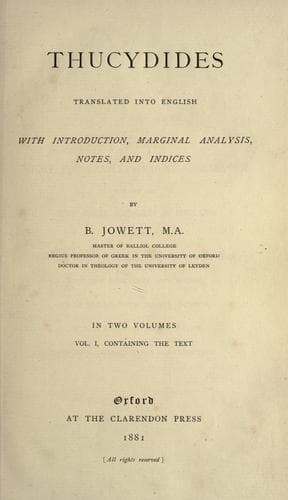
Greece -- History -- Peloponnesian War, 431-404 B.C.
Now the wall of the Peloponnesians was constructed as follows. It
consisted of two lines drawn round the place, one against the
Plataeans, the other against any attack on the outside from Athens,
about sixteen feet apart. The intermediate space of sixteen feet was
occupied by huts portioned out among the soldiers on guard, and built
in one block, so as to give the appearance of a single thick wall with
battlements on either side. At intervals of every ten battlements were
towers of considerable size, and the same breadth as the wall, reaching
right across from its inner to its outer face, with no means of passing
except through the middle. Accordingly on stormy and wet nights the
battlements were deserted, and guard kept from the towers, which were
not far apart and roofed in above.
Such being the structure of the wall by which the Plataeans were
blockaded, when their preparations were completed, they waited for a
stormy night of wind and rain and without any moon, and then set out,
guided by the authors of the enterprise. Crossing first the ditch that
ran round the town, they next gained the wall of the enemy unperceived
by the sentinels, who did not see them in the darkness, or hear them,
as the wind drowned with its roar the noise of their approach; besides
which they kept a good way off from each other, that they might not be
betrayed by the clash of their weapons. They were also lightly
equipped, and had only the left foot shod to preserve them from
slipping in the mire. They came up to the battlements at one of the
intermediate spaces where they knew them to be unguarded: those who
carried the ladders went first and planted them; next twelve
light-armed soldiers with only a dagger and a breastplate mounted, led
by Ammias, son of Coroebus, who was the first on the wall; his
followers getting up after him and going six to each of the towers.
After these came another party of light troops armed with spears, whose
shields, that they might advance the easier, were carried by men
behind, who were to hand them to them when they found themselves in
presence of the enemy. After a good many had mounted they were
discovered by the sentinels in the towers, by the noise made by a tile
which was knocked down by one of the Plataeans as he was laying hold of
the battlements. The alarm was instantly given, and the troops rushed
to the wall, not knowing the nature of the danger, owing to the dark
night and stormy weather; the Plataeans in the town having also chosen
that moment to make a sortie against the wall of the Peloponnesians
upon the side opposite to that on which their men were getting over, in
order to divert the attention of the besiegers. Accordingly they
remained distracted at their several posts, without any venturing to
stir to give help from his own station, and at a loss to guess what was
going on. Meanwhile the three hundred set aside for service on
emergencies went outside the wall in the direction of the alarm.
Public-domain text, read in full here on John Shaqi.
Reviews
Reviews
No reviews yet
Be the first to share your thoughts on this work.
Elsewhere in the archive
Join the Discussion
Join the discussion
Sign in to leave a comment or review.
Sign InorCreate an account