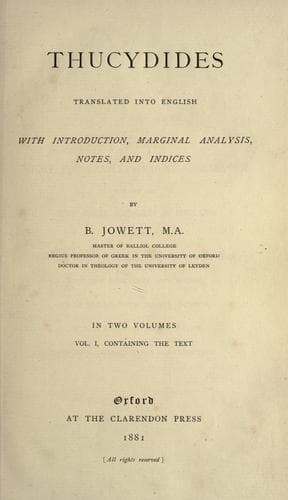
Greece -- History -- Peloponnesian War, 431-404 B.C.
remained quiet with his army in those parts, until the time should come
for the Ambraciots to take the field, and for him to join them before
Argos.
Summer was now over. The winter ensuing, the Athenians in Sicily with
their Hellenic allies, and such of the Sicel subjects or allies of
Syracuse as had revolted from her and joined their army, marched
against the Sicel town Inessa, the acropolis of which was held by the
Syracusans, and after attacking it without being able to take it,
retired. In the retreat, the allies retreating after the Athenians were
attacked by the Syracusans from the fort, and a large part of their
army routed with great slaughter. After this, Laches and the Athenians
from the ships made some descents in Locris, and defeating the
Locrians, who came against them with Proxenus, son of Capaton, upon the
river Caicinus, took some arms and departed.
The same winter the Athenians purified Delos, in compliance, it
appears, with a certain oracle. It had been purified before by
Pisistratus the tyrant; not indeed the whole island, but as much of it
as could be seen from the temple. All of it was, however, now purified
in the following way. All the sepulchres of those that had died in
Delos were taken up, and for the future it was commanded that no one
should be allowed either to die or to give birth to a child in the
island; but that they should be carried over to Rhenea, which is so
near to Delos that Polycrates, tyrant of Samos, having added Rhenea to
his other island conquests during his period of naval ascendancy,
dedicated it to the Delian Apollo by binding it to Delos with a chain.
The Athenians, after the purification, celebrated, for the first time,
the quinquennial festival of the Delian games. Once upon a time,
indeed, there was a great assemblage of the Ionians and the
neighbouring islanders at Delos, who used to come to the festival, as
the Ionians now do to that of Ephesus, and athletic and poetical
contests took place there, and the cities brought choirs of dancers.
Nothing can be clearer on this point than the following verses of
Homer, taken from a hymn to Apollo:
Phœbus, wherever thou strayest, far or near,
Delos was still of all thy haunts most dear.
Thither the robed Ionians take their way
With wife and child to keep thy holiday,
Invoke thy favour on each manly game,
And dance and sing in honour of thy name.
That there was also a poetical contest in which the Ionians went to
contend, again is shown by the following, taken from the same hymn.
After celebrating the Delian dance of the women, he ends his song of
praise with these verses, in which he also alludes to himself:
Public-domain text, read in full here on John Shaqi.
Reviews
Reviews
No reviews yet
Be the first to share your thoughts on this work.
Elsewhere in the archive
Join the Discussion
Join the discussion
Sign in to leave a comment or review.
Sign InorCreate an account