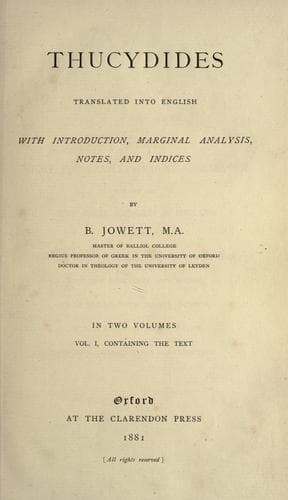
Greece -- History -- Peloponnesian War, 431-404 B.C.
this, the old must equal their ancient exploits, and the young, the
sons of the heroes of that time, must endeavour not to disgrace their
native valour; and trusting in the help of the god whose temple has
been sacrilegiously fortified, and in the victims which in our
sacrifices have proved propitious, we must march against the enemy, and
teach him that he must go and get what he wants by attacking someone
who will not resist him, but that men whose glory it is to be always
ready to give battle for the liberty of their own country, and never
unjustly to enslave that of others, will not let him go without a
struggle.”
By these arguments Pagondas persuaded the Boeotians to attack the
Athenians, and quickly breaking up his camp led his army forward, it
being now late in the day. On nearing the enemy, he halted in a
position where a hill intervening prevented the two armies from seeing
each other, and then formed and prepared for action. Meanwhile
Hippocrates at Delium, informed of the approach of the Boeotians, sent
orders to his troops to throw themselves into line, and himself joined
them not long afterwards, leaving about three hundred horse behind him
at Delium, at once to guard the place in case of attack, and to watch
their opportunity and fall upon the Boeotians during the battle. The
Boeotians placed a detachment to deal with these, and when everything
was arranged to their satisfaction appeared over the hill, and halted
in the order which they had determined on, to the number of seven
thousand heavy infantry, more than ten thousand light troops, one
thousand horse, and five hundred targeteers. On their right were the
Thebans and those of their province, in the centre the Haliartians,
Coronaeans, Copaeans, and the other people around the lake, and on the
left the Thespians, Tanagraeans, and Orchomenians, the cavalry and the
light troops being at the extremity of each wing. The Thebans formed
twenty-five shields deep, the rest as they pleased. Such was the
strength and disposition of the Boeotian army.
On the side of the Athenians, the heavy infantry throughout the whole
army formed eight deep, being in numbers equal to the enemy, with the
cavalry upon the two wings. Light troops regularly armed there were
none in the army, nor had there ever been any at Athens. Those who had
joined in the invasion, though many times more numerous than those of
the enemy, had mostly followed unarmed, as part of the levy in mass of
the citizens and foreigners at Athens, and having started first on
their way home were not present in any number. The armies being now in
line and upon the point of engaging, Hippocrates, the general, passed
along the Athenian ranks, and encouraged them as follows:
Public-domain text, read in full here on John Shaqi.
Reviews
Reviews
No reviews yet
Be the first to share your thoughts on this work.
Elsewhere in the archive
Join the Discussion
Join the discussion
Sign in to leave a comment or review.
Sign InorCreate an account