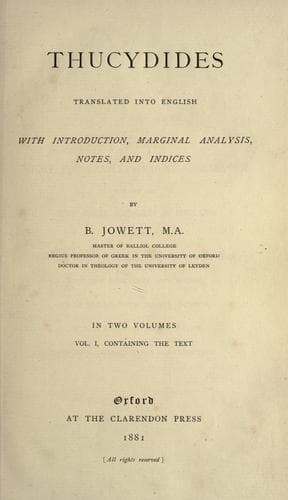
Greece -- History -- Peloponnesian War, 431-404 B.C.
5. This treaty shall be sworn to by the same persons on either side
that swore to the other. It shall be renewed annually by the
Lacedaemonians going to Athens for the Dionysia, and the Athenians to
Lacedaemon for the Hyacinthia, and a pillar shall be set up by either
party: at Lacedaemon near the statue of Apollo at Amyclae, and at
Athens on the Acropolis near the statue of Athene. Should the
Lacedaemonians and Athenians see to add to or take away from the
alliance in any particular, it shall be consistent with their oaths for
both parties to do so, according to their discretion.
Those who took the oath for the Lacedaemonians were Pleistoanax, Agis,
Pleistolas, Damagetus, Chionis, Metagenes, Acanthus, Daithus,
Ischagoras, Philocharidas, Zeuxidas, Antippus, Alcinadas, Tellis,
Empedias, Menas, and Laphilus; for the Athenians, Lampon, Isthmionicus,
Laches, Nicias, Euthydemus, Procles, Pythodorus, Hagnon, Myrtilus,
Thrasycles, Theagenes, Aristocrates, Iolcius, Timocrates, Leon,
Lamachus, and Demosthenes.
This alliance was made not long after the treaty; and the Athenians
gave back the men from the island to the Lacedaemonians, and the summer
of the eleventh year began. This completes the history of the first
war, which occupied the whole of the ten years previously.
CHAPTER XVI
Feeling against Sparta in Peloponnese—League of the Mantineans, Eleans,
Argives, and Athenians—Battle of Mantinea and breaking up of the League
After the treaty and the alliance between the Lacedaemonians and
Athenians, concluded after the ten years’ war, in the ephorate of
Pleistolas at Lacedaemon, and the archonship of Alcaeus at Athens, the
states which had accepted them were at peace; but the Corinthians and
some of the cities in Peloponnese trying to disturb the settlement, a
fresh agitation was instantly commenced by the allies against
Lacedaemon. Further, the Lacedaemonians, as time went on, became
suspected by the Athenians through their not performing some of the
provisions in the treaty; and though for six years and ten months they
abstained from invasion of each other’s territory, yet abroad an
unstable armistice did not prevent either party doing the other the
most effectual injury, until they were finally obliged to break the
treaty made after the ten years’ war and to have recourse to open
hostilities.
Public-domain text, read in full here on John Shaqi.
Reviews
Reviews
No reviews yet
Be the first to share your thoughts on this work.
Elsewhere in the archive
Join the Discussion
Join the discussion
Sign in to leave a comment or review.
Sign InorCreate an account